





The 2026 Complete Guide to Bidirectional Inverters: Beyond the Basics of Energy Storage
- What is a Bidirectional Inverter?
- Key Takeaways: Quick Summary for 2026
- How Bidirectional Inverters Differ from Traditional Inverters
- Core Components and Technical Architecture
- Top Applications: Microgrids, V2G, and Beyond
- Expert Tips & Common Installation Mistakes
- Pricing Data & 2026 Future Trends
- Industry Leading Solutions in Bidirectional Power
- Conclusion
- Can a bidirectional inverter work without a battery?
- Are hybrid inverters and bidirectional inverters the same?
- How much does a commercial bidirectional inverter cost?
- What is Vehicle-to-Grid (V2G) technology?
- Do bidirectional inverters provide pure sine wave output?
- How efficient is the AC/DC conversion process?
- What size bidirectional inverter do I need?
- Can bidirectional inverters be used for off-grid applications?
What is a Bidirectional Inverter?
A bidirectional inverter is an advanced power conversion device that converts alternating current (AC) to direct current (DC) to charge batteries, and seamlessly reverses the process (DC to AC) to discharge power back to the grid, enabling dynamic, two-way energy flow.
Historically, solar arrays and battery banks required completely separate hardware units to manage the incoming and outgoing flow of electricity. This dual functionality acts as the heart of modern Power Conversion Systems (PCS), practically eliminating the need for separate charging and inverting equipment. By drastically reducing the overall system footprint and electrical complexity, these advanced devices serve as the critical gateway in modern microgrids. They allow users to achieve true energy independence and resilience against grid failures. Furthermore, as renewable energy adoption accelerates, the ability to effortlessly switch between drawing power and supplying power without manual intervention ensures that no generated energy is ever wasted.
Key Takeaways: Quick Summary for 2026
In 2026, bidirectional technology operates as the essential backbone of modern battery storage, unlocking advanced energy management capabilities like peak shaving, load shifting, and utility grid stabilization to maximize financial returns and operational efficiency.
- Backbone of BESS: Bidirectional technology is the functional core of modern installations, as detailed in overviews of a Battery Energy Storage System on Wikipedia, allowing seamless integration with variable renewable energy sources.
- Advanced Features: They actively unlock critical energy management features, including peak shaving (reducing power consumption during maximum demand) and grid stabilization to prevent large-scale blackouts.
- V2G Integration: Integration with EV infrastructure is expanding rapidly, effectively turning everyday electric vehicles into mobile, dispatchable battery assets.
- Modular Designs: Scalable, plug-and-play modular designs are now the undisputed industry standard for commercial and industrial energy applications, drastically reducing deployment times.
How Bidirectional Inverters Differ from Traditional Inverters
Traditional inverters are strictly limited to one-way energy flow by converting DC to AC, whereas bidirectional inverters enable a dynamic, two-way energy exchange that allows electrical power to flow seamlessly from the grid to the battery and vice versa.
- Traditional Inverters: Limited to one-way energy flow, they simply convert DC power generated from solar panels or batteries into usable AC power for household or commercial use. Once the power is converted, it cannot be sent back to recharge the storage medium.
- Bidirectional Inverters: Capable of two-way dynamic energy exchange, they effortlessly manage inputs and outputs from multiple sources, automatically directing power to where it is most needed or most profitable.
- Cost vs. Efficiency: While bidirectional models inherently carry a higher upfront capital expenditure, their capacity to actively participate in compensated grid services offers a vastly superior long-term ROI.
- Future-Proofing: Traditional setups often require total equipment overhauls and complete replacements to add modern storage. Conversely, state-of-the-art hybrid battery storage inverters natively support evolving architectural demands without demanding additional retrofit hardware.
Core Components and Technical Architecture
The technical architecture of a bidirectional inverter relies on sophisticated AC/DC rectification and DC/AC inversion stages, forming the fundamental electrical pathways that expertly manage power direction, voltage levels, and overall energy quality for the user.
- AC/DC and DC/AC Stages: These are the foundational pathways meticulously managing power direction and maintaining strict power quality standards. They utilize advanced high-frequency switching to ensure energy loss is kept to an absolute minimum.
- Sine Amplitude Converters (SAC): This advanced internal topology guarantees a pure sine wave output, which is strictly mandatory for safely running sensitive electronics, medical devices, and heavy IT infrastructure.
- AI-Powered Energy Management System (EMS): An intelligent software integration continuously processes weather data, historical usage, and utility pricing. It automatically decides when to charge, store, or sell power back to the grid based on real-time electricity rates.
- Thermal Management Systems: These internal cooling mechanisms—ranging from forced-air fans to advanced liquid cooling—are critical for maintaining high efficiency and equipment longevity during high-load, continuous charge-discharge cycles.
Top Applications: Microgrids, V2G, and Beyond
The top applications for bidirectional inverters include vehicle-to-grid capabilities, commercial battery energy storage setups, utility-scale grid support, and remote off-grid power management, all designed to maximize energy independence and generate new revenue streams.
- Vehicle-to-Grid (V2G) and V2H: Empowering EV owners to power their homes during electrical outages or sell stored energy back during peak hours. This transformative capability is driven by Vehicle-to-Grid (V2G) technology, as documented extensively by Wikipedia.
- Commercial Battery Energy Storage Systems (BESS): Enabling large-scale businesses to perform automated peak shaving. By drawing on battery reserves during peak pricing periods, facilities can drastically reduce massive utility demand charges.
- Grid Support and Ancillary Services: Providing vital frequency regulation and voltage support to utility companies. System owners can participate in demand-response programs, opening up lucrative revenue streams.
- Off-Grid and Remote Power: Seamlessly managing inputs from solar arrays, backup diesel generators, and large battery banks in geographically isolated locations, ensuring uninterruptible power supply (UPS) capabilities.

Expert Tips & Common Installation Mistakes
To ensure optimal performance, always align your bidirectional inverter's capacity precisely with your battery specifications, prioritize intelligent software integration, and rigorously avoid poor thermal management or non-compliance with local utility interconnection standards.
- Tip: Always align your inverter's maximum output capacity and acceptable DC voltage range precisely with your battery bank specifications. This synergy ensures optimal charging efficiency and protects battery cell chemistry.
- Mistake: Ignoring ambient thermal management and proper ventilation in modular setups. Placing high-powered inverters in unventilated rooms inevitably leads to thermal throttling and premature component degradation.
- Tip: Prioritize purchasing units equipped with built-in, AI-driven EMS software. These intelligent systems effectively remove human error from the equation and maximize your financial return through entirely automated peak shaving.
- Mistake: Failing to proactively account for local grid compliance, rapid shutdown requirements, and necessary interconnection standards before purchasing equipment, which can result in costly failed inspections.
Pricing Data & 2026 Future Trends
In 2026, residential bidirectional inverters typically range from $2,000 to $4,500, while commercial modular units scale from $10,000 to over $50,000, heavily driven by emerging high-frequency soft-switching technologies and standardized EV integration protocols.
- Residential Cost Expectations: Modern 5kW to 10kW bidirectional hybrid inverters installed in standard residential homes typically range from $2,000 to $4,500, heavily depending on integrated smart features, warranties, and the manufacturer's brand reputation.
- Commercial and Industrial (C&I) Pricing: Enterprise-grade modular units logically scale up based on wattage, ranging from $10,000 to well over $50,000 for complex, utility-grade megawatt systems requiring custom deployment.
- 2026 Trend 1: The rapid rise of high-frequency soft-switching technologies alongside Silicon Carbide (SiC) components is currently pushing AC/DC conversion efficiencies beyond the 98% threshold, reducing wasted heat.
- 2026 Trend 2: Ubiquitous V2G integration is rapidly transitioning from a pilot-program concept to everyday reality, especially as major global automakers standardize bidirectional charging hardware protocols across their fleet lines.
Industry Leading Solutions in Bidirectional Power
Choosing a reliable, high-performance module is critical when scaling energy infrastructure; industry-leading bidirectional power solutions feature state-of-the-art architecture designed specifically to meet rigorous commercial, industrial, and utility-scale energy demands effortlessly.
When scaling your energy infrastructure, choosing a proven, high-performance module is the difference between operational success and frequent downtime. At Guangzhou Congsin Electronic Technology Co., Ltd., we bring over 27 years of focused, hands-on experience to the table. Founded in early 1998, we purposefully design, research, and manufacture a wide range of reliable power solutions. We operate fully automated production lines equipped with advanced instrumentation and multifunctional testing equipment to guarantee the highest efficiency and intelligent functionality.
Because environmental and safety compliance are built directly into our DNA, our quality management system is strictly ISO9001 certified. Furthermore, our expansive catalog of over 100 power product models holds critical international approvals—including CE, EMC, LVD, ETL, FCC, RoHS, and E-MARK.
- Case Study Highlight: Discover how implementing our AI-optimized bidirectional pure sine wave inverter significantly improved a commercial client's overall energy ROI by 30% within the very first year, strictly through automated load shifting and targeted demand charge reductions.
- Seamless Integration: Our advanced modular designs ensure absolute zero transfer time, redundant system reliability, and seamless API integration with existing smart grid energy management software platforms.
- Global Reach: Serving robust markets across Europe, the Americas, the Middle East, Africa, and Southeast Asia, our OEM/ODM support capabilities ensure that global distribution partners receive tailored, bespoke customization to meet any local grid specification.
Conclusion
Bidirectional inverters are no longer just an optional luxury; they have evolved into a fundamental technical requirement for anyone seriously looking to maximize the inherent value of their battery storage arrays, solar panel investments, and modern electric vehicles.
By natively enabling two-way power flow, these advanced systems physically transform static, one-way energy setups into dynamic, revenue-generating assets. Whether your primary goal is aiming for true off-grid energy independence, participating in lucrative utility demand-response programs, or simply looking to stabilize local grids against blackouts, selecting the right high-efficiency equipment makes all the difference. Are you ready to future-proof your facility's energy infrastructure and unlock the absolute full potential of your commercial or residential storage system?
Contact us today to optimize your smart grid energy management strategy.
Can a bidirectional inverter work without a battery?
No, a bidirectional inverter requires a battery or another DC power source to store and discharge energy effectively. Without a storage medium, there is nowhere to direct the converted AC power. They are specifically engineered to interface between an AC grid and a DC battery system.
Are hybrid inverters and bidirectional inverters the same?
They are closely related, but not strictly the same. A bidirectional inverter specifically refers to the capability of two-way power conversion (AC to DC and DC to AC). Most modern hybrid inverters include bidirectional capabilities to manage solar panels, battery storage, and grid connections simultaneously.
How much does a commercial bidirectional inverter cost?
Costs vary widely based on capacity and features. Small commercial units (around 30kW) may start between $5,000 and $10,000. Utility-scale modular cabinets and larger installations can exceed $50,000, not including installation and battery costs.
What is Vehicle-to-Grid (V2G) technology?
V2G allows electric vehicles to act as mobile batteries. A bidirectional EV charger or inverter takes the DC power stored in the car's battery and converts it to AC. This power is then sent back to the home or the public electrical grid during times of peak demand.
Do bidirectional inverters provide pure sine wave output?
Yes, high-quality bidirectional inverters utilize pure sine wave technology. This is crucial for safely powering sensitive electronics and appliances without causing damage or interference. Pure sine wave output closely replicates the smooth, consistent power supplied by the utility grid.
How efficient is the AC/DC conversion process?
Modern bidirectional inverters are highly efficient, typically boasting conversion efficiencies between 95% and 98%. Advanced topologies, like soft-switching and silicon carbide (SiC) components, help minimize heat and energy loss during the conversion cycle.
What size bidirectional inverter do I need?
Sizing depends on two main factors: your peak electrical load (the maximum amount of power you need at one time) and the total capacity of your battery storage system. It is recommended to consult with an energy specialist to perform a load analysis to ensure you do not undersize or drastically oversize the unit.
Can bidirectional inverters be used for off-grid applications?
Absolutely. In off-grid scenarios, they are essential for managing multiple power sources, such as solar arrays and backup diesel generators. They seamlessly direct excess generator or solar power to charge the battery bank, and then invert battery power for use when those sources are inactive.
UPS vs Inverter: Choosing the Right Backup Power System
Safety and Certification Standards for Car Inverters

10 Crucial Tips for Maximizing Efficiency with a 1000W Modified Sine Wave Inverter in 2026
1000W Car Inverter Buying Guide: Features & Specs to Compare
Modified Sine Wave Inverters
What devices can this inverter support?
It can power laptops, phones, cameras, and other small appliances.
Can I customize the color and logo?
Yes, OEM/ODM customization is supported.
Is customization available?
OEM/ODM support for logo, color, and packaging design.
What is the working principle of the UPS function?
When the external power supply is normal, the inverter powers the device and charges the battery; when the external power supply is interrupted, it automatically switches to battery power to ensure uninterrupted operation of the device.
Pure Sine Wave Inverters
What is the difference between a pure sine wave inverter and a modified sine wave inverter?
Pure sine wave inverter has an output waveform close to mains power with low distortion rate (<3%), which can be safely adapted to precision devices such as computers, medical instruments, and inverter home appliances; modified sine wave inverter has a notched waveform, which easily causes device heating, malfunction or damage, and is only suitable for simple devices such as bulbs and fans.
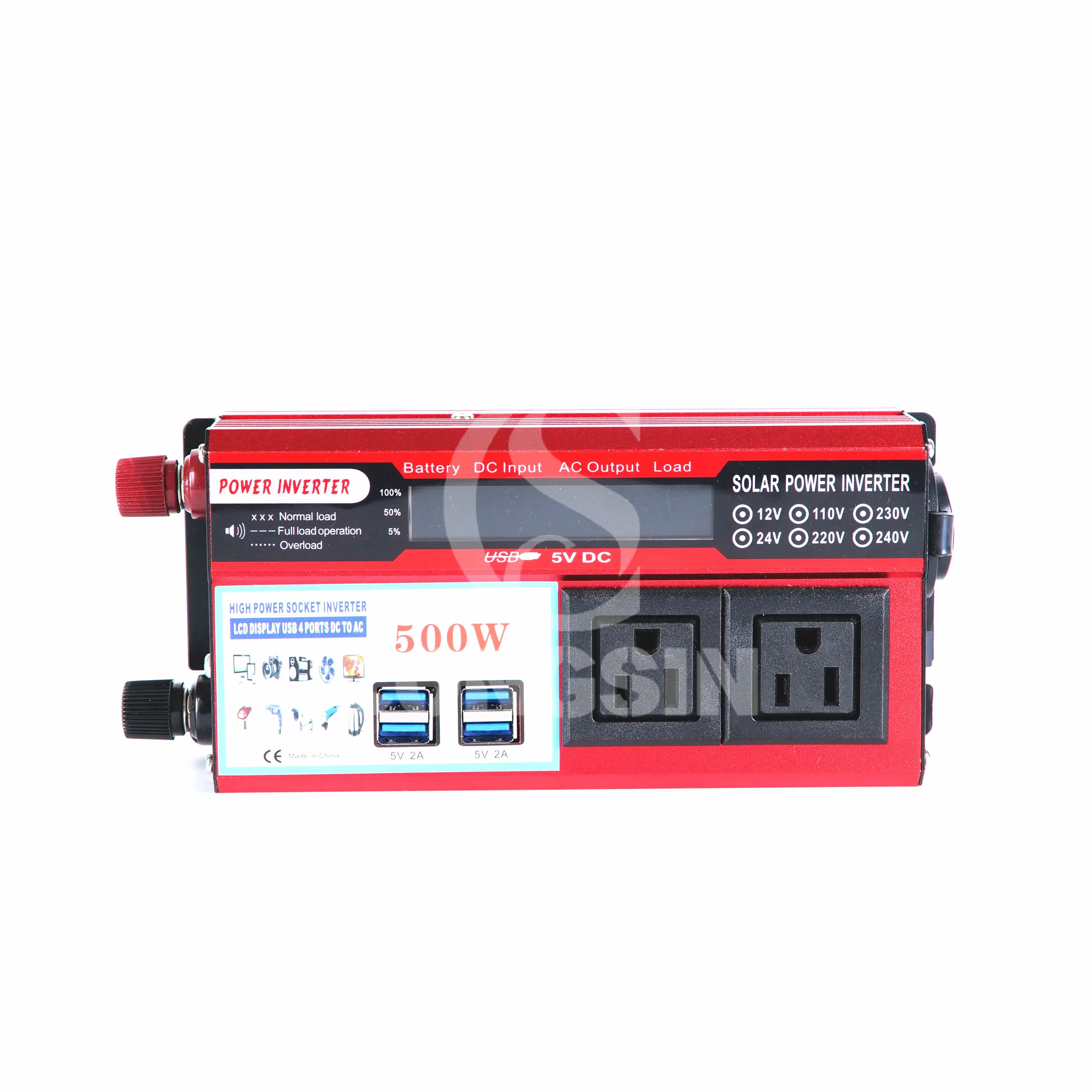
Congsin 500W modified sine wave power inverter US sockets 4 USB ports LCD display off grid
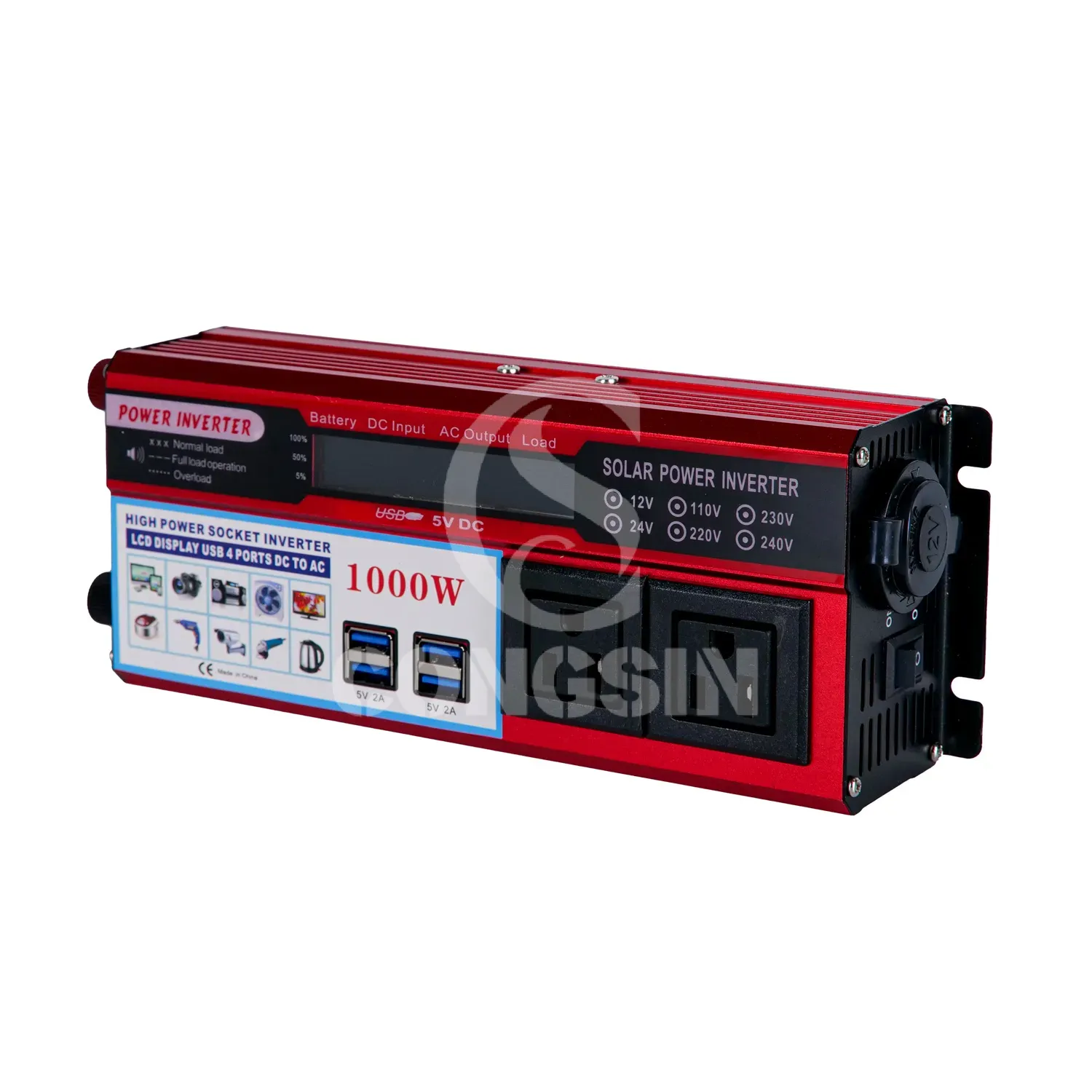
Congsin 1000W modified sine wave inverter with American Sockets and Lcd display portable 12V car RV
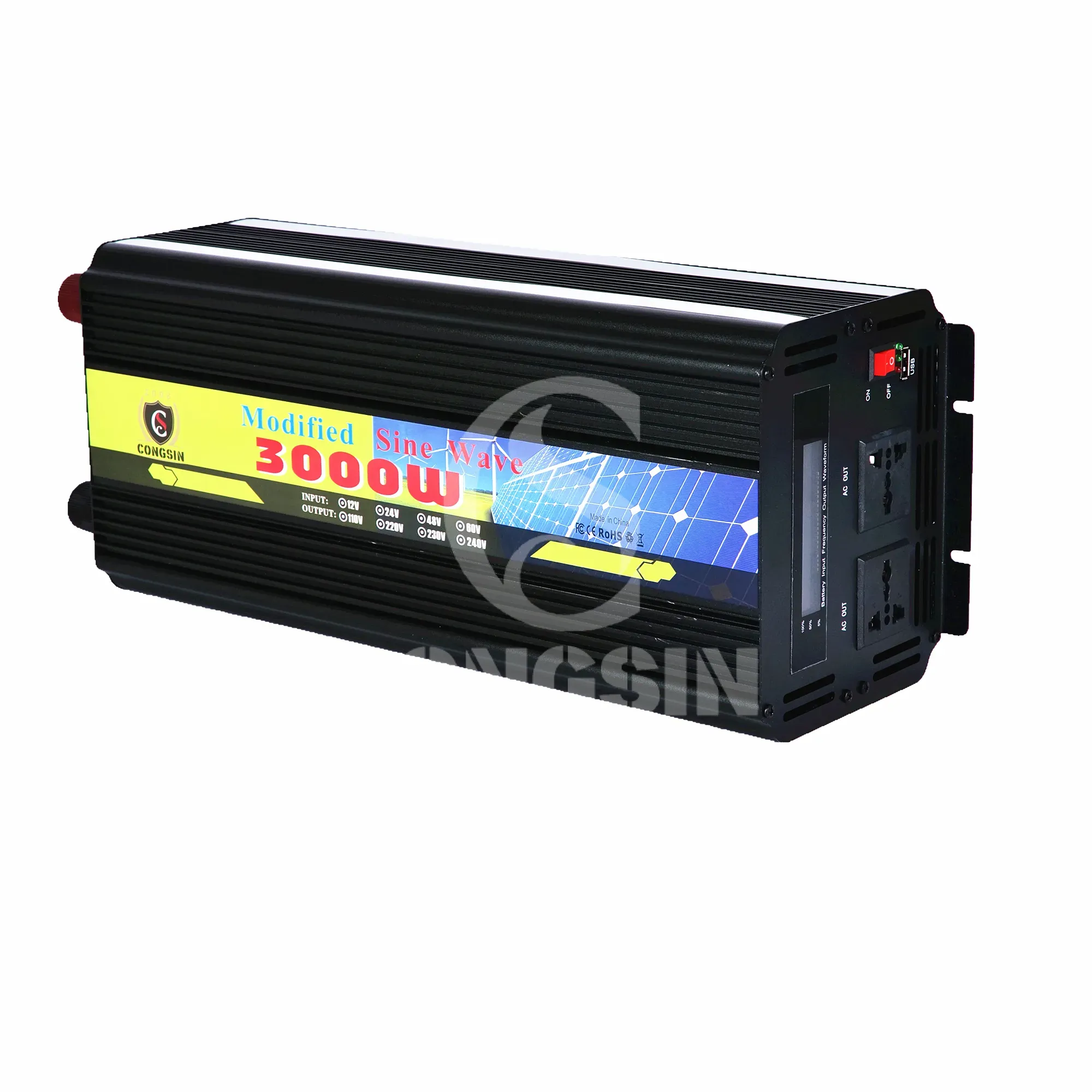
Congsin Full Power 3000W Modified Sine Wave Inverter Peak Power 6000W with LCD Display RV Solar
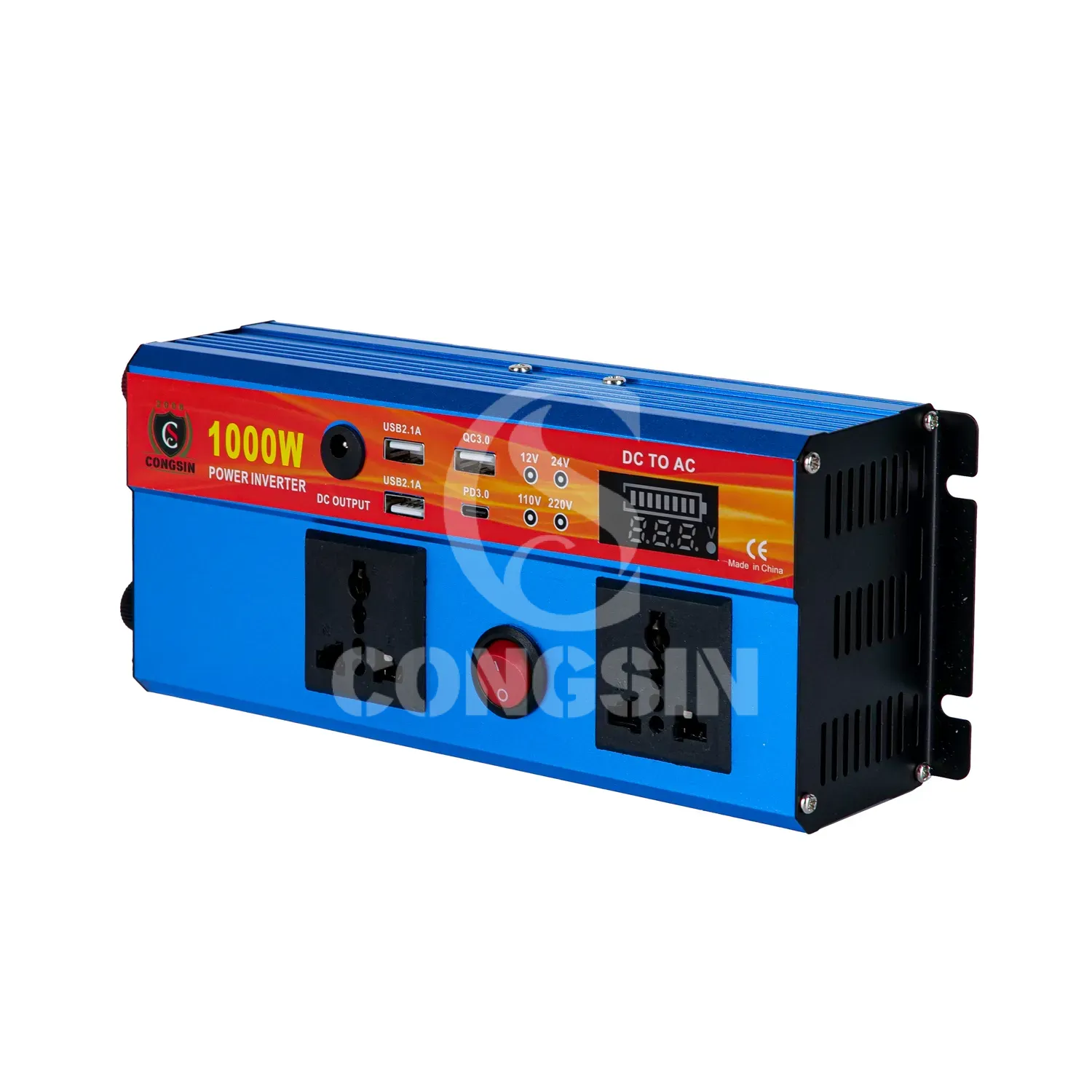
Congsin 1000W modified sine wave inverter with LED display and Type C port car RV power inverter

CONGSIN is a trusted OEM factory for power inverters, solar charge controllers, and DC converters. Reliable solutions for global B2B buyers.
 High Quality
 7/24 Service
 Guaranteed Warranty
© 2025 Congsin. All Rights Reserved.