





Best MPPT Charge Controllers for RVs, Boats and Remote Sites
- Why MPPT matters for mobile and off-grid power
- How MPPT charge controllers work
- Benefits compared with PWM and common tradeoffs
- Typical performance expectations
- Top MPPT charge controller options by application
- Small systems: RV rooftop and small boats (≤ 200 W PV)
- Mid-range systems: Larger RV installs, cruising yachts, remote cabins (200–1000 W PV)
- High-power systems: Remote sites, commercial boats, off-grid homes (>1000 W PV)
- How to choose and size an MPPT charge controller
- 1) Match PV Voc and controller input voltage
- 2) Size the controller current relative to battery charging needs
- 3) Consider battery chemistry and charge profiles
- 4) Environmental & mounting considerations
- Installation, maintenance and common pitfalls
- Wiring, fusing and safety
- Battery temperature compensation and charge accuracy
- Troubleshooting reduced harvest
- Manufacturers, OEM sourcing and why component provenance matters
- Why source from experienced manufacturers
- Guangzhou Congsin Electronic Technology Co., Ltd. — capabilities and advantages
- Comparative advantages to check when evaluating suppliers
- FAQ — common questions about MPPT charge controllers
- Q1: Do I always need an MPPT charge controller for an RV or boat?
- Q2: How do I size MPPT current capacity?
- Q3: Can MPPT controllers charge lithium batteries?
- Q4: What maintenance does an MPPT controller need?
- Q5: How important is MPPT tracking range and algorithm?
- Q6: What certifications should I look for?
- Further reading and authoritative references
I have designed and commissioned dozens of off-grid and mobile solar systems for RVs, marine vessels and remote sites. In my experience an appropriately specified MPPT charge controller is one of the highest-value components in those systems: it maximizes energy harvest, reduces battery stress and often pays for itself by improving system efficiency. This article walks through how MPPT charge controllers work, how to size and pick one for a vehicle, boat or remote installation, direct comparisons across power classes, installation and troubleshooting best practices, and why sourcing quality hardware from experienced manufacturers matters for system reliability.
Why MPPT matters for mobile and off-grid power
How MPPT charge controllers work
Maximum Power Point Tracking (MPPT) is a DC-DC conversion technique that continuously finds the PV array operating point that delivers maximum power and converts the panel voltage to the battery charging voltage while optimizing current. Practically this means an MPPT charge controller can convert excess PV voltage into extra charging current—so a higher-voltage panel string can charge a lower-voltage battery more efficiently than a simple PWM controller. For the underlying science see the Wikipedia overview of MPPT: https://en.wikipedia.org/wiki/Maximum_power_point_tracking.
Benefits compared with PWM and common tradeoffs
Compared with PWM controllers, MPPT controllers typically increase usable energy by 10–30% depending on solar conditions, array-to-battery voltage mismatch and temperature. An MPPT is particularly beneficial when: the PV open-circuit voltage is significantly higher than battery voltage, partial shading or temperature variation is present, or higher system efficiency is required in limited roof/roofline area (common on RVs and boats). The tradeoffs are higher unit cost and slightly greater electronic complexity; however modern MPPT controllers are mature and reliable when sourced from reputable manufacturers.
Typical performance expectations
Real-world MPPT efficiency (power conversion) is commonly 95–99% for good-quality controllers; overall energy harvest gains versus PWM depend on array and conditions. For context and industry discussion see the solar charge controller overview: https://en.wikipedia.org/wiki/Solar_charge_controller.
Top MPPT charge controller options by application
Below I categorize controllers by typical use-case and system size, then provide a comparison table with recommended models and key specifications. Use the category to narrow choice quickly, then check exact product datasheets against your array and battery requirements.
Small systems: RV rooftop and small boats (≤ 200 W PV)
For compact mobile systems, you want a controller with good low-voltage tracking, a small form-factor, and support for lithium and lead-acid charge profiles. Look for built-in Bluetooth or app support if you frequently monitor from a phone.
Mid-range systems: Larger RV installs, cruising yachts, remote cabins (200–1000 W PV)
Mid-range systems need higher continuous current ratings (30–80 A typical), robust thermal management for hot cabins or engine rooms, and flexible PV input voltage ranges. Dual-MPPT or parallel-capable controllers can simplify wiring when multiple panel strings are used.
High-power systems: Remote sites, commercial boats, off-grid homes (>1000 W PV)
For larger installations, look for controllers with high voltage input (to minimize string current), high continuous current, scalable parallel or multi-MPPT architectures, and rigorous certifications for system integration. Redundancy and communications for monitoring are often necessary in remote critical installations.
| Category | Example Models (well-known) | Typical Max PV Voc | Typical Max Charge Current | Notes |
|---|---|---|---|---|
| Small (≤200 W) | Victron SmartSolar 75/15, Renogy Rover 20 A | ~100–75 V | 10–30 A | Bluetooth monitoring, compact, good for 12 V & 24 V systems |
| Mid (200–1000 W) | EPEVER Tracer AN 40–60 A, Victron SmartSolar 100/50 | ~100–150 V | 30–80 A | Better heat sinks, multi-stage charging, often MPPT efficiency ~97–99% |
| High (>1000 W) | Morningstar TriStar MPPT 60 A, OutBack FlexMax 80 A, EPEVER 100 A+ | ~150–250 V | 60–150 A+ | Scalable, industrial features, required for large off-grid systems |
Note: exact Voc and current ratings depend on the model and manufacturer. Always check the manufacturer's datasheet for the specific product. Manufacturer product pages are a good source for final specs—example: Victron SmartSolar series https://www.victronenergy.com/solar-charge-controllers/smartsolar, EPEVER (now a major MPPT OEM) https://www.epever.com/.
How to choose and size an MPPT charge controller
1) Match PV Voc and controller input voltage
Always ensure PV array open-circuit voltage (Voc) at the coldest expected temperature does not exceed the MPPT controller's maximum input Voc. In cold climates Voc increases; datasheets often specify a maximum Voc rating (for example 150–250 V). Overspecifying array Voc relative to controller input is a common installation mistake that risks device failure.
2) Size the controller current relative to battery charging needs
Calculate expected maximum charging current roughly as: Peak PV power (W) ÷ battery nominal voltage (V). Then select a controller with continuous current rating at least 25% higher than that number to provide margin and comply with common design practice (and electrical code considerations). Example: 600 W PV charging a 12 V battery → 600/12 = 50 A nominal; choose a controller ≥ 60–75 A.
3) Consider battery chemistry and charge profiles
Modern MPPT controllers offer configurable charge profiles for flooded lead-acid, AGM, gel and multiple lithium chemistries. Lithium batteries require precise voltage control and often a communication interface (CAN/RS485/BMS input) for full control of state-of-charge and charge termination. For guidance on lithium charging and battery management see Battery University: https://batteryuniversity.com/article/bu-808-charging-lithium-ion.
4) Environmental & mounting considerations
On boats and RVs you must consider vibration, temperature extremes, and salt spray. Choose controllers with appropriate IP ratings, conformal coating, marine approvals or robust enclosures. Adequate ventilation and derating at high ambient temperatures are essential—manufacturers provide derating curves in datasheets.
Installation, maintenance and common pitfalls
Wiring, fusing and safety
Use appropriately sized conductors and follow the controller datasheet for maximum DC input and output wiring sizes. Install DC fuses or breakers on the PV and battery circuits as recommended by the manufacturer. In the U.S., NEC guidance (and local codes) generally require overcurrent protection sized to system currents—adhere to local electrical codes and marine wiring standards where applicable.
Battery temperature compensation and charge accuracy
Temperature affects battery charge voltage. Good MPPT controllers offer temperature sensor inputs for automatic compensation; this is important for lead-acid batteries in outdoor enclosures or cold climates. Without compensation you risk under- or overcharging, which shortens battery life.
Troubleshooting reduced harvest
If energy yield is lower than expected, check these items: PV string orientation/tilt and shading, degraded or dirty panels, Voc/cold-weather effects pushing array out of optimal MPPT range, incorrect battery voltage setting in the controller, cabling losses, or thermal derating. Modern controllers with data logging simplify root-cause analysis.
Manufacturers, OEM sourcing and why component provenance matters
Why source from experienced manufacturers
Quality of the MPPT algorithm implementation, parts selection (capacitors, MOSFETs), thermal design and firmware robustness determine long-term reliability. For commercial or mission-critical remote installations, procurement from a manufacturer that runs automated production and tests each unit reduces field failures and warranty costs.
Guangzhou Congsin Electronic Technology Co., Ltd. — capabilities and advantages
Guangzhou Congsin Electronic Technology Co., Ltd., founded in early 1998, is a professional power inverter manufacturer with over 27 years of focused experience. We design, R&D and manufacture a wide range of power solutions—with a core emphasis on DC→AC power inverters, portable power stations, and solar charge controllers. Our catalog includes 100+ models tailored for vehicles, solar systems, RVs and trucks, off-grid homes, outdoor offices, patrol and field construction work.
We operate fully automated production lines, advanced instrumentation and multifunctional testing equipment to ensure product reliability, efficiency and intelligent functionality. Environmental and safety compliance are built in: our quality system is ISO9001 certified and many products hold international approvals such as CE, EMC, LVD, ETL, FCC, RoHS and E-MARK. Several independently developed patents further demonstrate our commitment to innovation.
Congsin’s products serve global markets across Europe, the Americas, the Middle East, Africa and Southeast Asia; many models are supplied to domestic and international OEM channels. Our support includes OEM/ODM, private labeling, distribution and bespoke customization to meet partner specifications. Key product lines relevant to this article include Solar Charge Controller, modified sine wave inverter, pure sine wave inverter and portable power stations.
Why this matters for your MPPT selection: working with a manufacturer like Congsin means access to configurable firmware (for battery charge profiles), scalable production for fleet projects, and international certifications that ease cross-border deployments. If you need manufacturer-side customization—different MPPT voltage ranges, communication interfaces (CAN/Modbus/Bluetooth), or marine-grade housings—these are services Congsin provides.
Comparative advantages to check when evaluating suppliers
- ISO-certified quality management and third-party product approvals (CE/ETL/FCC).
- Automated production lines and test logs for traceability.
- Experience with OEM/ODM and the ability to deliver custom charge curves or BMS integration.
FAQ — common questions about MPPT charge controllers
Q1: Do I always need an MPPT charge controller for an RV or boat?
A1: Not always. For very small single-panel 12 V systems (low power, low cost) a PWM controller may be acceptable. However, for typical RV rooftop arrays, cruising boats with limited panel area, or remote sites where energy yield matters, an MPPT charge controller is strongly recommended because it significantly increases daily harvested energy and handles variable conditions better.
Q2: How do I size MPPT current capacity?
A2: Estimate peak charging current as PV wattage divided by battery nominal voltage (W/V). Add a margin (commonly 25%) and choose the next available controller rating. Also ensure PV Voc (cold) is below controller maximum input Voc.
Q3: Can MPPT controllers charge lithium batteries?
A3: Yes—most modern MPPT controllers support lithium charge profiles, but you must configure them to the battery manufacturer’s recommended charge voltages and charge termination behavior. For best results with LiFePO4 and other chemistries, consider controllers that offer BMS communication or external BMS integration.
Q4: What maintenance does an MPPT controller need?
A4: Minimal maintenance: keep ventilation clear, inspect wiring and terminals periodically, update firmware if the manufacturer provides updates, and monitor logs for error conditions. In marine environments inspect for corrosion and consider conformal-coated boards or marine-rated enclosures.
Q5: How important is MPPT tracking range and algorithm?
A5: Very important. A controller with a wide MPPT voltage tracking range can work well with higher-voltage panel strings and under varied light conditions. Advanced algorithms and fast tracking respond better to transient shading and rapidly changing irradiance, improving overall harvest.
Q6: What certifications should I look for?
A6: Look for ISO9001 for manufacturing quality, CE/EMC/LVD for European compliance, ETL or UL for North American safety (if required by local code), and RoHS for environmental compliance. For automotive and marine applications, E-MARK or marine standards may be relevant.
Further reading and authoritative references
- MPPT basics — Wikipedia: https://en.wikipedia.org/wiki/Maximum_power_point_tracking
- Solar charge controller overview — Wikipedia: https://en.wikipedia.org/wiki/Solar_charge_controller
- Battery charging theory — Battery University: https://batteryuniversity.com/article/bu-808-charging-lithium-ion
If you need help specifying the right MPPT charge controller for an RV, boat or remote site—whether it’s a single-unit retail purchase or a customized OEM solution—contact our team to discuss system requirements, or view our product catalog for Solar Charge Controller, modified sine wave inverter, pure sine wave inverter and portable power stations. For manufacturing capabilities and custom projects, Guangzhou Congsin Electronic Technology Co., Ltd. can support OEM/ODM, private labeling and bespoke solutions to meet your specifications.
Contact us to request datasheets, perform system sizing, or discuss custom firmware and hardware configurations.
Top Pure Sine Wave Inverter Models for Commercial Use 2026
Bidirectional Inverter Buyer's Guide: Choose the Right Model
Maintenance Best Practices to Extend UPS Power Inverter Life
Cost Analysis: Pure Sine Wave Inverters for Backup Power
Pure Sine Wave Inverters
Can this inverter drive a 3P air conditioner and a refrigerator at the same time?
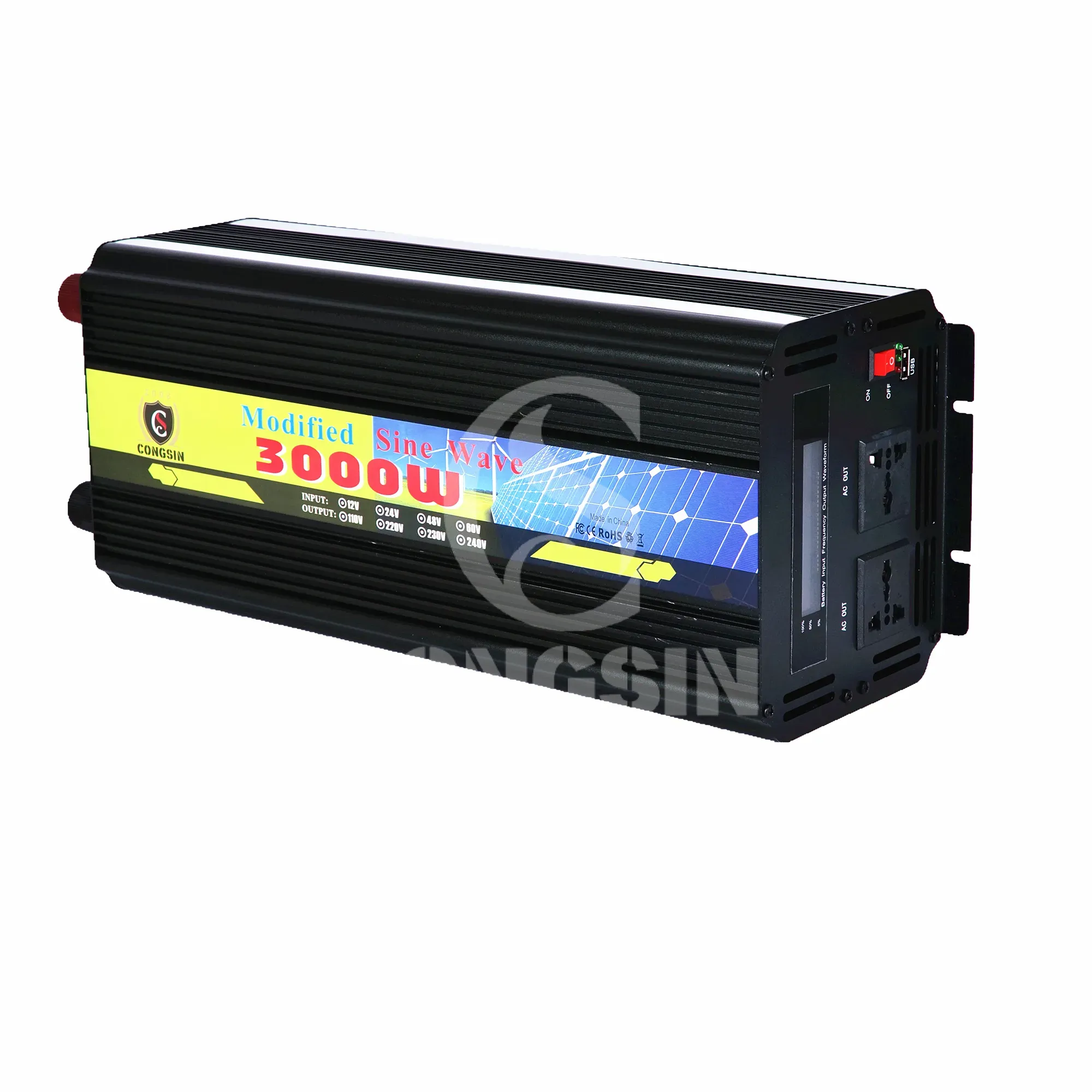
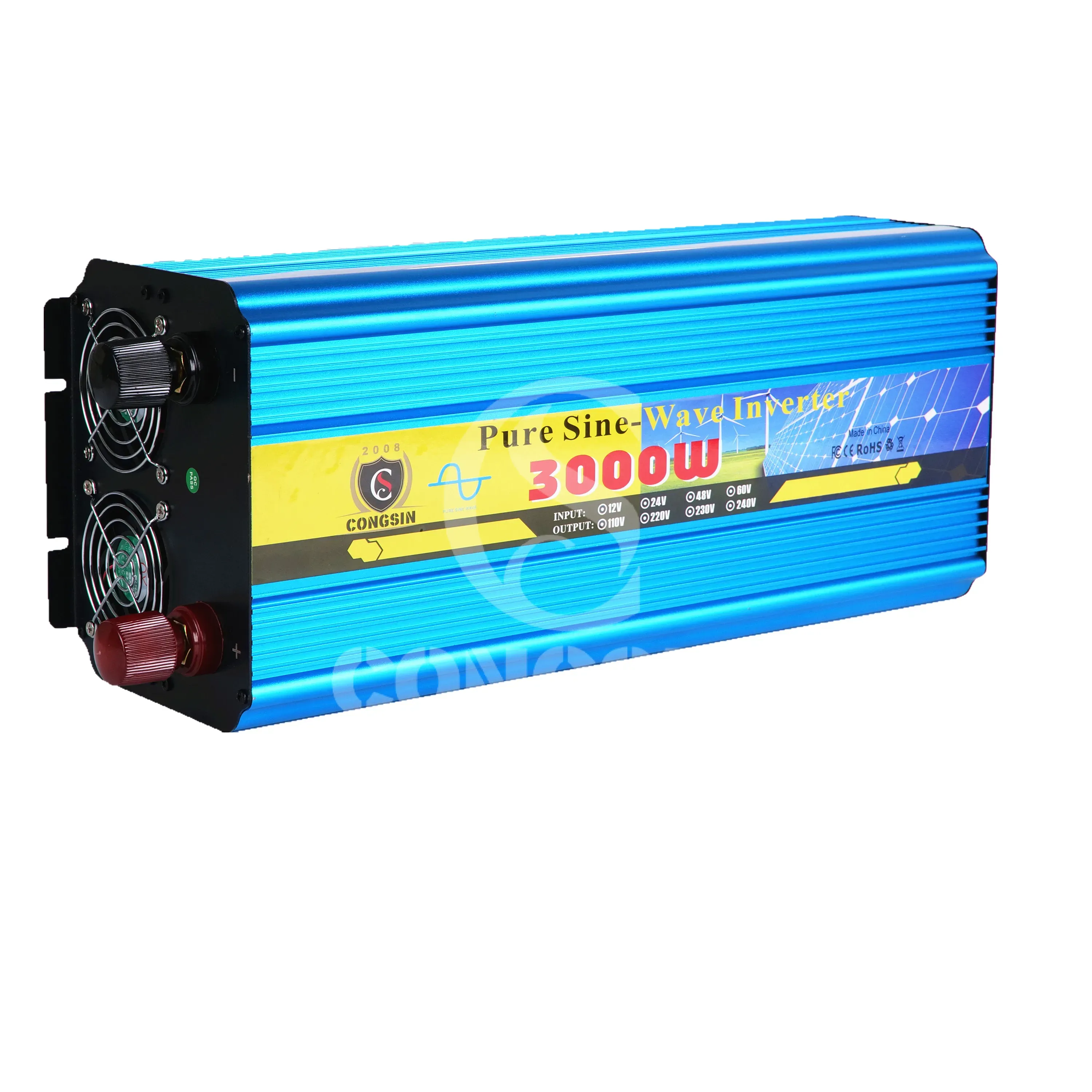
Yes. The rated power of a 3P air conditioner is about 2200W-2500W, and an ordinary double-door refrigerator is about 150W-300W, with a total power of about 2350W-2800W, which does not exceed the 3000W continuous power; and the peak 6000W can cope with the instantaneous startup impact of the air conditioner. When using, ensure the battery capacity is ≥200Ah (12V) to ensure battery life.
Modified Sine Wave Inverters
Is the cooling fan noisy during operation?
The noise is low (≤45 decibels, equivalent to normal conversation volume). The fan uses a silent motor and automatically adjusts the speed according to the device temperature (low-speed operation when temperature <40℃, high-speed operation when >60℃), balancing heat dissipation and noise.
Does the UPS function require additional mains connection?
Yes. The inverter needs to be connected to a home/office socket via the included mains cable, and the device will automatically detect the mains status; when the mains power is interrupted, it will switch to battery power immediately.
Can it be connected to a battery long-term?
Yes, ensure good ventilation to avoid overheating.
Distributor
How long does it take to become an authorized distributor?
The process typically takes 2-4 weeks, depending on the discussion and agreement finalization.
Congsin Full Power 3000W Modified Sine Wave Inverter Peak Power 6000W with LCD Display RV Solar
Congsin 3000W LCD Pure Sine Wave Inverter for Home Use Solar Backup Power Inverter Off Grid UPS
Congsin Modified Sine Wave Inverter 500W 1000W 1500W 12V LED Display Portable for RV Car Solar
Congsin 1000W modified sine wave inverter with LED display and Type C port car RV power inverter

CONGSIN is a trusted OEM factory for power inverters, solar charge controllers, and DC converters. Reliable solutions for global B2B buyers.
 High Quality
 7/24 Service
 Guaranteed Warranty
© 2025 Congsin. All Rights Reserved.