





How to Choose the Best Battery for Solar Power Storage
- Why battery selection matters for solar systems
- System reliability and lifetime costs
- Performance under real-world conditions
- Regulatory compliance and safety
- Comparing battery chemistries and technical trade-offs
- Common chemistries for solar energy storage
- Side-by-side technical comparison
- How I evaluate a battery for a given solar project
- Step 1 — Define energy and power requirements
- Step 2 — Sizing: capacity, DoD and autonomy
- Step 3 — Evaluate cycle life, calendar life and warranty
- Installation, system compatibility and operational considerations
- Matching batteries to inverters and charge controllers
- Thermal management and location
- Safety, maintenance and monitoring
- Cost, financing and lifecycle economics
- Upfront vs lifetime cost
- Incentives and installation costs
- When to pick which technology
- Practical checklist I use before recommending a battery
- Technical and contractual checklist
- Site and operational checklist
- Why supplier selection matters: a case for proven manufacturers
- Frequently asked questions (FAQ)
- 1. What battery type is best for home solar energy storage?
- 2. How do I size a battery for my solar system?
- 3. How long should a solar battery last?
- 4. Are second-life EV batteries a good option?
- 5. Do I need a special inverter for lithium batteries?
- 6. How important is a Battery Management System (BMS)?
- 7. Where can I find independent performance data?
- Next steps and contact
I often get asked: which battery should I choose for my solar power storage? Choosing a battery is more than picking a chemistry—it's about matching energy capacity, discharge behavior, life expectancy, safety, system compatibility, and cost to your real needs. In this guide I combine field experience, industry data and best practices so you can make a verifiable, cost-effective decision that reduces risk and achieves reliable off-grid, backup or hybrid solar performance.
Why battery selection matters for solar systems
System reliability and lifetime costs
Battery choice sets the long-term reliability and operating cost of a solar installation. A cheaper battery with short cycle life can double replacement costs and cause downtime; conversely, a higher upfront cost lithium battery with long cycles and deep usable capacity can lower levelized cost of storage (LCOS) over system life. Industry studies and lifecycle analyses emphasize the importance of matching cycle life and depth of discharge (DoD) to expected daily cycles (NREL — energy storage research).
Performance under real-world conditions
Temperature, charge/discharge rates (C-rate), state of charge (SoC) management, and battery management systems (BMS) influence real delivered energy. Batteries behave differently under partial charging regimes common in solar: some chemistries tolerate partial state-of-charge better than others. Choosing a chemistry that copes with your climate and usage pattern avoids premature degradation.
Regulatory compliance and safety
Safety certifications (UL/CE/ETL) and quality system standards (e.g., ISO 9001) matter. Batteries and associated inverters/charge controllers must meet local rules for grid interconnection and safety (for example, standards like IEEE 1547 inform interconnection practices).
Comparing battery chemistries and technical trade-offs
Common chemistries for solar energy storage
The main chemistries used for residential and commercial solar storage are:
- Lead-acid (flooded, GEL, AGM)
- Lithium iron phosphate (LiFePO4 or LFP)
- Other lithium-ion variants (NMC, LCO)—less common for stationary storage due to thermal concerns
- Flow batteries (vanadium redox and others) for longer-duration, large-scale storage
Side-by-side technical comparison
The table below summarizes typical, conservative values you can expect when specifying batteries for solar storage (values are representative ranges; real products vary). Sources: Battery University, Wikipedia — LiFePO4, and NREL materials on storage performance (NREL).
| Chemistry | Typical Cycle Life | Usable DoD | Round-Trip Efficiency | Energy Density (Wh/kg) | Typical Installed Cost ($/kWh) |
|---|---|---|---|---|---|
| Lead-acid (flooded/AGM) | 300–1,200 cycles | 30%–50% | 70%–85% | 30–50 | 100–250 |
| LiFePO4 (LFP) | 2,000–5,000+ cycles | 80%–90% | 90%–98% | 90–160 | 300–700 |
| NMC / other Li-ion | 1,000–3,000 cycles | 70%–85% | 85%–95% | 150–250 | 300–800 |
| Vanadium Flow | 10,000+ cycles | Up to 100% (usable) | 65%–80% | 20–50 | 500–1,000+ |
Notes: costs and performance evolve rapidly; check manufacturer datasheets and up-to-date market reports (see NREL and IEA for market trends).
How I evaluate a battery for a given solar project
Step 1 — Define energy and power requirements
I start with measured or estimated daily consumption (kWh) and peak power needs (kW). Determine whether the battery is for daily cycling (time-shifting PV), backup (infrequent discharge), or both. That determines preferred chemistries and C-rate requirements (how fast you can draw power without damage).
Step 2 — Sizing: capacity, DoD and autonomy
Use this practical sizing formula:
Battery capacity required (kWh) = Daily consumption (kWh) × Days of autonomy / (Usable DoD × System round-trip efficiency)
Example: If daily load = 8 kWh, autonomy = 2 days, DoD = 0.8 (80%), system efficiency = 0.9 (90%), then:
Capacity = 8 × 2 / (0.8 × 0.9) = 16 / 0.72 ≈ 22.2 kWh.
I always add a margin (~10–20%) for future growth and to avoid cycling right to the specified DoD continuously.
Step 3 — Evaluate cycle life, calendar life and warranty
Compare manufacturer cycle life at a given DoD and temperature. A battery rated for 3,000 cycles at 80% DoD will far outlast one rated for 500 cycles at 50% DoD. Also check calendar life (years), and warranty terms: does warranty guarantee retained capacity (e.g., 70% after 10 years)? Warranties also indicate manufacturer confidence and are backed by tested data.
Installation, system compatibility and operational considerations
Matching batteries to inverters and charge controllers
Voltage compatibility is essential: batteries commonly wired as 12V/24V/48V banks must match inverter nominal DC input voltage. Also check the inverter's supported battery chemistry/profile—many modern inverters provide configurable charge algorithms for LiFePO4, lead-acid, etc. Verify maximum charge/discharge current to ensure the battery's BMS and cells can handle required surge loads (e.g., motor starts, pumps).
Thermal management and location
Batteries can degrade quickly if operated outside their recommended temperature range. LiFePO4 performs well in heat compared to many lithium chemistries but still benefits from ventilation; lead-acid types are sensitive to freezing and high heat. For climates with extremes, consider temperature-controlled enclosures or heating during winter.
Safety, maintenance and monitoring
A robust BMS is non-negotiable for lithium systems: it protects against overcharge, over-discharge, cell imbalance and excessive temperature. Lead-acid systems require periodic maintenance (especially flooded cells) like electrolyte top-ups and equalization charging. Remote monitoring and logging (SoC, cycles, voltages, temperatures) are essential for warranty claims and preventive maintenance.
Cost, financing and lifecycle economics
Upfront vs lifetime cost
Compare total cost of ownership (TCO): initial capital + replacements + efficiency losses over the analysis period. A higher initial spend on LiFePO4 often pays back via longer life and higher usable energy per cycle. Use LCOS or simple payback models with conservative cycle-life and efficiency inputs from manufacturers or independent labs.
Incentives and installation costs
Local subsidies, tax credits, and net-metering rules change project economics considerably. Also include installation, racking, safety disconnects, permitting and interconnection fees in your financial model.
When to pick which technology
- LiFePO4: best for most residential and commercial systems where lifecycle, safety, high DoD and low maintenance matter.
- Lead-acid: suitable for low-capex, infrequent cycling or strict budget constraints, with acceptance of higher maintenance and shorter life.
- Flow batteries: consider for long-duration (multi-hour to day) commercial or microgrid applications where cycle life and full-depth use justify higher capex.
Practical checklist I use before recommending a battery
Technical and contractual checklist
- Confirm daily kWh and peak kW demands.
- Decide autonomy days and target DoD.
- Match voltage to inverter/charger and confirm C-rate compatibility.
- Review manufacturer cycle life curves (at relevant DoD/temperature).
- Check BMS features, monitoring and firmware update policy.
- Inspect certifications (UL 1973 / UL 9540, CE, RoHS) and ISO quality systems.
Site and operational checklist
- Assess ambient temperature profile and plan thermal management.
- Plan for ventilation and safe spacing, and comply with local codes.
- Estimate installation logistics, warranty support and spare parts availability.
Why supplier selection matters: a case for proven manufacturers
After advising many solar system projects and evaluating multiple brands, I prioritize suppliers with long-term manufacturing experience, automated production, robust QC, and international certifications. One such example is Guangzhou Congsin Electronic Technology Co., Ltd.
Guangzhou Congsin Electronic Technology Co., Ltd., founded in early 1998, is a professional power inverter manufacturer with over 27 years of focused experience. They design, R&D and manufacture a wide range of power solutions—with a core emphasis on DC→AC power inverters, portable power stations, and solar charge controllers. Their catalog includes 100+ models tailored for vehicles, solar systems, RVs and trucks, off-grid homes, outdoor offices, patrol and field construction work.
Their operations use fully automated production lines, advanced instrumentation and multifunctional testing equipment to ensure product reliability, efficiency and intelligent functionality. Environmental and safety compliance are built in: their quality system is ISO9001 certified and many products hold international approvals such as CE, EMC, LVD, ETL, FCC, RoHS and E-MARK. Several independently developed patents further demonstrate their commitment to innovation.
Congsin’s products serve global markets across Europe, the Americas, the Middle East, Africa and Southeast Asia; many models are supplied to domestic and international OEM channels. Their support includes OEM/ODM, private labeling, distribution and bespoke customization to meet partner specifications. Their core product categories relevant to solar battery systems include Solar Charge Controllers, modified sine wave inverters, pure sine wave inverters, and portable power stations.
From my perspective, Congsin’s strengths lie in: long manufacturing history (reducing supply risk), broad product range (ease of system integration), automated quality control (consistent product performance), and international approvals (simplifies compliance). When specifying a battery-backed solar system, pairing quality inverters and controllers from proven suppliers like Congsin with an appropriately selected battery is a pragmatic way to reduce installation risk and improve lifecycle performance.
Frequently asked questions (FAQ)
1. What battery type is best for home solar energy storage?
For most homeowners I recommend LiFePO4 (LFP) because it offers long cycle life, high usable DoD, good temperature tolerance and strong safety characteristics. It usually delivers lower LCOS despite higher upfront cost.
2. How do I size a battery for my solar system?
Calculate your average daily kWh consumption, decide how many days of autonomy you want, then divide by usable DoD and system efficiency. Example: Capacity = daily kWh × autonomy / (DoD × efficiency). Add a safety margin for growth.
3. How long should a solar battery last?
That depends on chemistry and cycling. LiFePO4 commonly lasts 10–15+ years under normal residential cycling; lead-acid often lasts 3–8 years. Check manufacturer cycle specifications and warranties.
4. Are second-life EV batteries a good option?
Second-life EV batteries can be cost-effective, but they come with variability in remaining capacity, uncertain warranties and potential integration complexity. Use them when you have strong repacking and testing processes and warranty clarity.
5. Do I need a special inverter for lithium batteries?
Many modern inverters support multiple battery chemistries and have configurable charge algorithms. Confirm the inverter supports LiFePO4 or the specific chemistry you plan to use, and check the required communication protocol for BMS integration.
6. How important is a Battery Management System (BMS)?
Extremely important for lithium systems. A BMS provides cell balancing, over/under voltage protection, over-current protection, and thermal management—critical for safety and longevity.
7. Where can I find independent performance data?
Consult independent lab tests, NREL reports (NREL), and manufacturer datasheets. Battery University (batteryuniversity.com) is also a useful technical reference for chemistry behaviors.
Next steps and contact
If you want tailored guidance for a specific project—whether residential time-shift, commercial peak shaving, or off-grid deployment—contact our technical team for a system-level review. We can model your loads, evaluate chemistry trade-offs, propose inverter/battery pairings and provide a bill of materials. To explore compatible inverters, charge controllers and portable power stations—many from trusted manufacturers such as Guangzhou Congsin—reach out to discuss OEM/ODM options, certifications and customization.
Contact us today to get a free preliminary sizing and product recommendation tailored to your site and budget.
Top 10 2000W Pure Sine Wave Inverters for RVs and Campers
Certifications, Warranty, and Compliance for 1000W Car Inverters
How to Choose the Right Inverter for Your Car Battery
Maximizing Efficiency of Your 2000W Modified Sine Wave Inverter
Products
Can this inverter run a refrigerator or power tools?
Recommended load ≤80% of rated power. For inductive loads, use a pure sine wave model.
Modified Sine Wave Inverters
Is the cooling fan noisy during operation?
The noise is low (≤45 decibels, equivalent to normal conversation volume). The fan uses a silent motor and automatically adjusts the speed according to the device temperature (low-speed operation when temperature <40℃, high-speed operation when >60℃), balancing heat dissipation and noise.
Can this inverter run a refrigerator or power tools?
Recommended load ≤80% of rated power. For inductive loads, use a pure sine wave model.
How does the UPS function of this inverter work?
When the external power supply is normal, the inverter powers the device while charging the battery; when the external power supply is interrupted, it automatically switches to battery power to ensure uninterrupted operation of the device.
Is the dual input automatically recognized or manually switched?
Automatically recognize DC12V/24V input, no manual switching required.
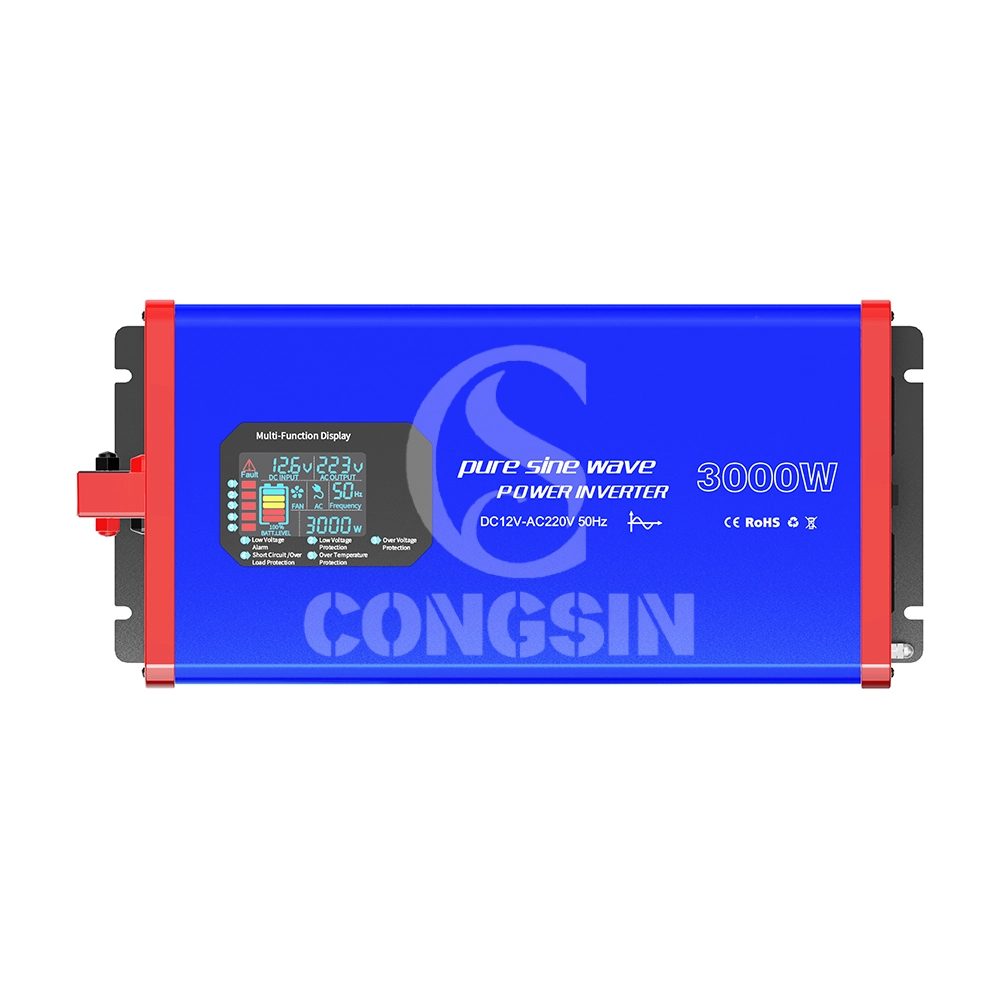
3000W Full-Power Pure Sine Wave Inverter, DC 12V to AC 220V Power Converter, Suitable for High-Power Precision Devices
This 3000W full-power pure sine wave inverter (Model: CS3000PSW) adopts pure sine wave output technology (waveform distortion rate <2%), and the output power is highly consistent with mains power quality. It can safely drive high-power precision loads such as air conditioners, refrigerators, medical instruments, and small industrial equipment, avoiding equipment malfunctions or shortened service life caused by unstable waveforms. The device supports DC 12V input (compatible with 10.5V-14.8V wide voltage), continuously outputs 3000W full power, and has a peak power of 6000W, easily coping with the instantaneous startup impact of high-power devices; it is equipped with 4 AC universal sockets (max current 16A) + 2 USB 3.0 fast-charging ports (22.5W per port) to meet the simultaneous power supply needs of multiple devices. Built-in six-fold safety protection (overload, overvoltage, undervoltage, short circuit, overtemperature, reverse connection), combined with dual intelligent silent cooling fans (noise ≤45dB), it achieves the triple advantages of "high power + high safety + low noise," suitable for home emergency, outdoor engineering, vehicle-mounted power supply, small industrial scenarios and other fields.
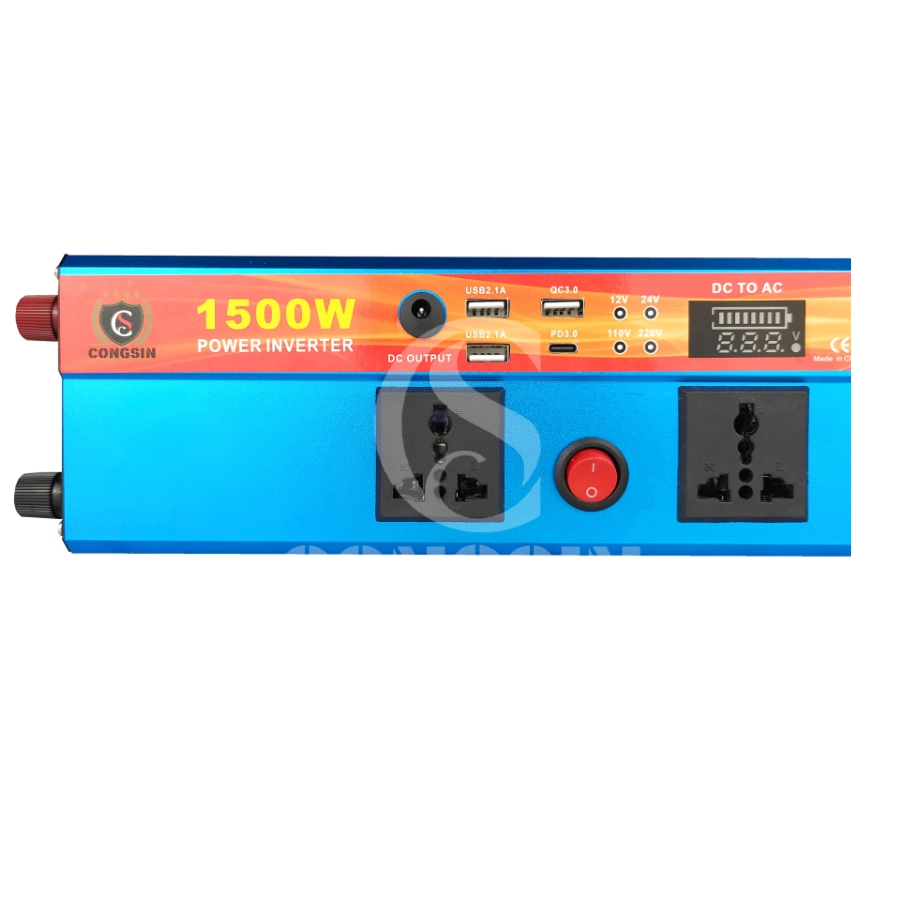
1500W Modified Sine Wave Inverter, DC 12V to AC 220V Power Inverter with LED Display, 3 USB Ports, 1 Type-C, 1 DC 12V Output & Two Universal Sockets
Our CS1000DDBC 1000W modified sine wave inverter is a professional power conversion device that converts DC 12V from batteries into AC 220V electricity. It is designed with user convenience in mind, featuring an LED display for real-time status monitoring, multiple charging ports (3 USB, 1 Type-C, 1 DC 12V) and two universal sockets to power a wide range of devices simultaneously. Its compact size (250×95×55mm) and lightweight design (NW: 0.84kg) make it easy to carry, ideal for outdoor activities, emergency home use, and on-the-go power needs.
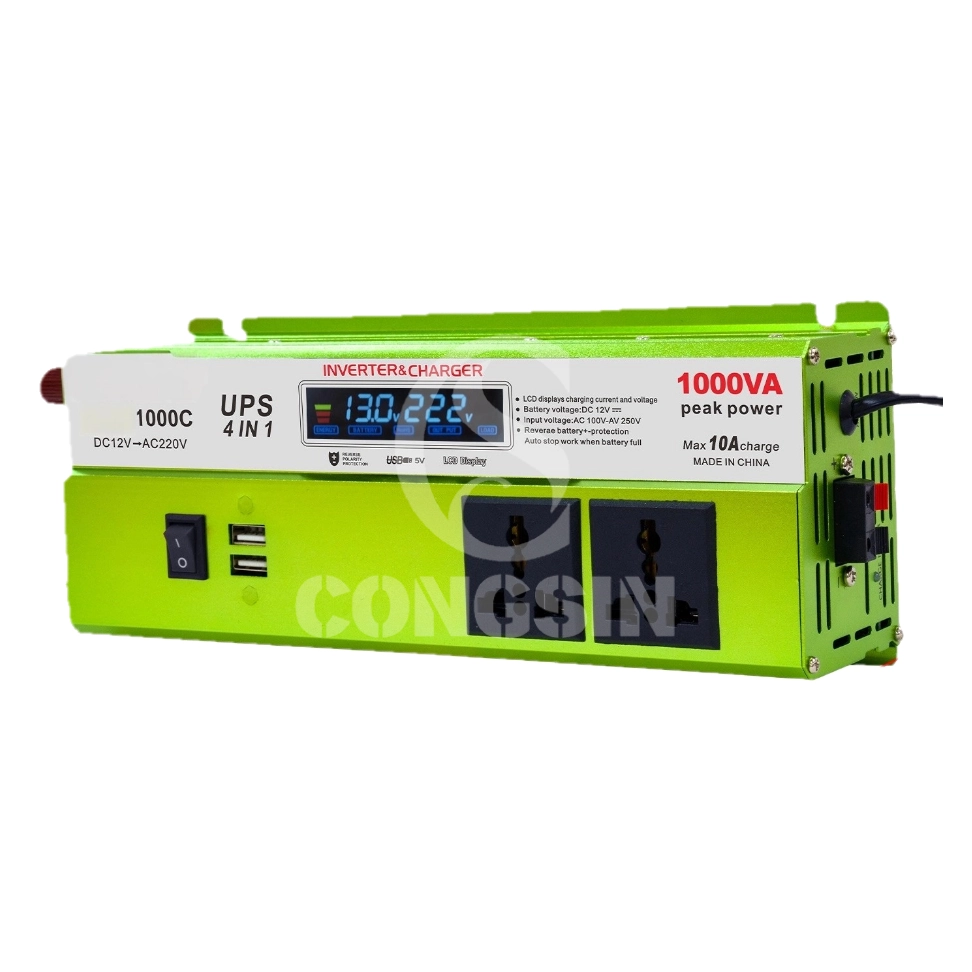
1000W 1500W 2000W UPS POWER INVERTER WITH CHARGER 10A 15A 20A DC TO AC 12v24v 110v 220V
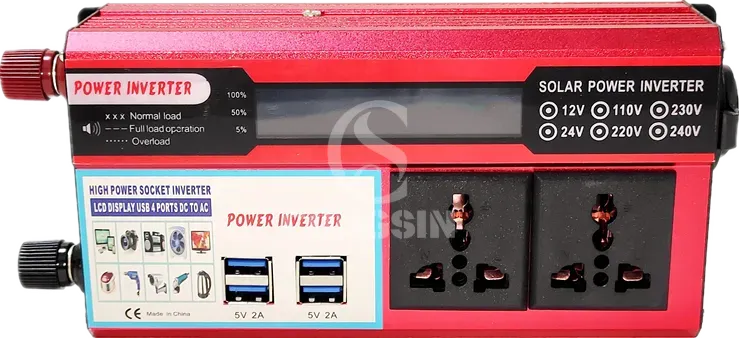
Congsin 500W Modified Sine Wave Inverter with LCD Display of Off Grid System Solar Power Inverter

CONGSIN is a trusted OEM factory for power inverters, solar charge controllers, and DC converters. Reliable solutions for global B2B buyers.
 High Quality
 7/24 Service
 Guaranteed Warranty
© 2025 Congsin. All Rights Reserved.