





Battery Compatibility: Best Batteries for UPS Inverters
- Choosing the right backup power strategy
- Understand the user intent: backup duration vs. power quality
- UPS inverter categories and their battery expectations
- Battery types and compatibility with UPS inverters
- Lead‑acid family: flooded, AGM, gel
- Lithium family: LiFePO4 and other lithium chemistries
- Compatibility checklist I use
- Sizing batteries and estimating runtime for UPS inverters
- Step‑by‑step runtime calculation
- Practical table: typical battery types, cycle life, usable DoD, suitability for UPS inverter
- Installation, charging behavior and long‑term maintenance
- Charging profiles and inverter charger settings
- Temperature effects and placement
- Monitoring, BMS and safety
- Recommendations for common scenarios
- Short emergency PC/IT UPS (minutes of runtime)
- Extended home backup or small server (1–8 hours)
- Off‑grid solar + UPS inverter (days or repeated cycles)
- Large data center or telecom UPS (redundant arrays)
- Why I recommend partnering with experienced inverter manufacturers
- Frequently Asked Questions (FAQ)
- 1. Can I replace my UPS lead‑acid batteries with LiFePO4?
- 2. What nominal battery voltage do most UPS inverters use?
- 3. How do I calculate the battery capacity I need for X hours of backup?
- 4. Are gel batteries better than AGM for ups inverter use?
- 5. How does temperature affect battery life and backup performance?
- 6. What protections should be in place for a battery bank connected to an inverter?
- 7. How often should UPS batteries be tested or replaced?
I write from years of hands‑on work with inverters, backup systems and battery banks. In this article I summarize how to match batteries to an ups inverter for reliable backup power: which chemistries work best, how capacity and C‑rate affect runtime, charging and BMS nuances, thermal and cycle life trade‑offs, and practical selection and maintenance steps for different use cases—from small office UPS to off‑grid solar inverters. I reference standards and authoritative sources so you can verify the recommendations.
Choosing the right backup power strategy
Understand the user intent: backup duration vs. power quality
When people search for ups inverter and battery compatibility they usually want one of three outcomes: keep critical electronics running for minutes to gracefully shut down; provide hours of backup for small servers or home essentials; or support extended off‑grid power with solar. Your battery choice depends primarily on required runtime, allowable depth of discharge (DoD), physical constraints, weight limits, and budget.
UPS inverter categories and their battery expectations
Small online or line‑interactive UPS units (for PCs, network gear) typically expect sealed lead‑acid (SLA) batteries with short high‑current discharge capacity. In contrast, inverter/charger systems used in solar or off‑grid applications pair well with deep‑cycle lead‑acid or lithium batteries designed for frequent cycling. When I evaluate compatibility I always check the inverter's recommended battery voltage, max charge voltage, and recommended chemistry—manufacturer specs matter. For UPS technical context, see the Wikipedia overview on Uninterruptible power supply.
Battery types and compatibility with UPS inverters
Lead‑acid family: flooded, AGM, gel
Lead‑acid batteries are the traditional choice for UPS inverters. They are mature, affordable, and tolerant of high surge currents—useful for short‑duration UPS loads. Subtypes:
- Flooded (wet) lead‑acid: lowest cost per Ah, requires ventilation and maintenance (water top‑up); good for large stationary battery banks.
- AGM (Absorbent Glass Mat): sealed, maintenance‑free, better cycle life than basic flooded when used as deep cycle; widely used in rackmount UPS modules.
- Gel: sealed, tolerant of deep discharges but sensitive to overcharging; less common in modern UPS due to charging nuance.
Typical cycle life and behavior is summarized in the comparison table below.
Lithium family: LiFePO4 and other lithium chemistries
Lithium iron phosphate (LiFePO4) is my recommended lithium chemistry for most UPS inverter applications because of its safety, long cycle life, and flat discharge curve. Li‑ion (NMC) offers higher energy density but typically higher cost and thermal management needs. Key advantages of LiFePO4:
- Higher usable depth of discharge (often 80–100% with a BMS), meaning smaller bank for same usable energy.
- Long cycle life (2,000–5,000 cycles depending on conditions), dramatically lowering total cost of ownership versus lead‑acid.
- Lower effective internal resistance improves efficiency and supports sustained high discharge currents.
Because LiFePO4 requires a Battery Management System (BMS) and a charge profile sometimes different from lead‑acid, ensure your UPS inverter's charger can be configured (or use an external charger) to suit LiFePO4. For general LiFePO4 background see Lithium iron phosphate battery (Wikipedia).
Compatibility checklist I use
Before approving a battery type for an ups inverter I verify:
- Nominal voltage match (e.g., 12V, 24V, 48V battery bank).
- Charger/charger‑profile compatibility: max charge voltage, charge stages (bulk/absorption/float) and whether they are configurable for LiFePO4 float voltage (if used).
- Peak discharge and C‑rate capability of battery relative to inverter surge ratings.
- Environmental limits: operating temperature range and ventilation needs.
- Recommended DoD for target cycle life and warranty terms.
Sizing batteries and estimating runtime for UPS inverters
Step‑by‑step runtime calculation
I follow a practical formula to estimate backup time:
- List continuous load in watts (W).
- Decide inverter efficiency (η). Typical values: 85–95% depending on inverter and waveform.
- Compute required DC power from battery = Load (W) / inverter efficiency.
- Choose battery nominal voltage (V) and usable capacity in Ah (accounting for DoD): Usable Ah = Rated Ah × usable DoD.
- Runtime (hours) ≈ (Usable Ah × V) / Required DC power (W).
Example: A 600 W load on a 48 V LiFePO4 bank, inverter efficiency 92%, required DC ≈ 652 W. With a 100 Ah 48 V battery (4.8 kWh nominal) and 90% usable DoD ≈ 4.32 kWh usable, runtime ≈ 4.32 kWh / 0.652 kW ≈ 6.6 hours.
Practical table: typical battery types, cycle life, usable DoD, suitability for UPS inverter
| Battery Type | Typical Cycle Life | Usable DoD | Energy Density (Wh/kg) | Best Use with UPS |
|---|---|---|---|---|
| Flooded Lead‑Acid | 200–800 cycles (deep cycle variants) | 30–50% (recommended to extend life) | 30–50 | Large stationary banks where ventilation & maintenance acceptable |
| AGM | 400–1200 cycles | 50% (some deep‑cycle AGM tolerate 60%) | 30–50 | Rackmount UPS, short‑duration backups, limited ventilation |
| Gel | 400–1000 cycles | 50% (sensitive to overcharge) | 30–50 | Environments needing deep discharge tolerance but careful charge control |
| LiFePO4 | 2000–5000+ cycles | 80–100% (with BMS) | 90–160 | Long runtime, high cycle applications, compact/portable UPS |
Sources: industry data and overviews such as Lead‑acid (Wikipedia) and LiFePO4 (Wikipedia), and technical battery encyclopedias like Battery University.
Installation, charging behavior and long‑term maintenance
Charging profiles and inverter charger settings
One frequent compatibility issue is float and absorption voltages. Lead‑acid chargers use higher float voltages and multi‑stage charging. LiFePO4 batteries prefer a different float and typically do not need a traditional float stage; overcharging LiFePO4 is less tolerated in terms of BMS behavior. If your inverter's charger is not configurable for LiFePO4 charge voltages, use an external, compatible charger or ensure the inverter manufacturer approves LiFePO4 use.
Temperature effects and placement
Battery capacity and cycle life are temperature dependent: higher temperatures increase available capacity but reduce lifetime; low temperatures reduce available capacity and can cause charging issues (especially for lithium). Lead‑acid batteries tolerate colder climates better for charging with appropriate compensation, while many LiFePO4 systems require temperature‑controlled charging to prevent damage below 0°C. For factory and quality standards, see ISO quality standards and specific inverter safety standards such as IEC 62040 (UPS standard overview).
Monitoring, BMS and safety
I always recommend a monitored battery with a proven BMS for lithium or a temperature‑compensated charger for lead‑acid. For larger installations, integrate battery state‑of‑charge (SoC), voltage, and temperature telemetry into the inverter or separate monitoring gateway. Proper overcurrent protection, fusing, and regular visual inspections are part of a safe maintenance routine.
Recommendations for common scenarios
Short emergency PC/IT UPS (minutes of runtime)
Recommendation: AGM sealed lead‑acid connected to a line‑interactive or online UPS. AGMs are cost‑effective, provide required surge currents and are maintenance‑free for indoor rack deployments.
Extended home backup or small server (1–8 hours)
Recommendation: LiFePO4 battery bank paired with a configurable inverter/charger. The higher usable DoD and cycle life make LiFePO4 the lowest total cost for daily/weekly cycling. Ensure inverter charger supports LiFePO4 or add a dedicated charger.
Off‑grid solar + UPS inverter (days or repeated cycles)
Recommendation: LiFePO4 for frequent cycling and solar integration; consider a hybrid inverter/charger with MPPT solar charge controller. For off‑grid where budget is tight, flooded lead‑acid deep cycle can be used if you can accept maintenance and shorter life.
Large data center or telecom UPS (redundant arrays)
Recommendation: Many facilities still use VRLA (sealed lead‑acid) with well‑engineered maintenance programs. LiFePO4 is increasingly used for modular UPS systems where energy density, cycle life, and lower maintenance are priorities—evaluate vendor‑approved systems and compliance to standards.
Why I recommend partnering with experienced inverter manufacturers
Compatibility is not only a battery chemistry decision—it’s a system design issue: charger curves, inverter firmware, factory warranties, and safety certifications matter. As a vendor partner I value suppliers who provide tested compatibility matrices and customization options.
Guangzhou Congsin Electronic Technology Co., Ltd., founded in early 1998, is a professional power inverter manufacturer with over 27 years of focused experience. We design, R&D and manufacture a wide range of power solutions—with a core emphasis on DC→AC power inverters, portable power stations, and solar charge controllers. Our catalog includes 100+ models tailored for vehicles, solar systems, RVs and trucks, off‑grid homes, outdoor offices, patrol and field construction work.
We operate fully automated production lines, advanced instrumentation and multifunctional testing equipment to ensure product reliability, efficiency and intelligent functionality. Environmental and safety compliance are built in: our quality system is ISO9001 certified and many products hold international approvals such as CE, EMC, LVD, ETL, FCC, RoHS and E‑MARK. Several independently developed patents further demonstrate our commitment to innovation.
Congsin’s products serve global markets across Europe, the Americas, the Middle East, Africa and Southeast Asia; many models are supplied to domestic and international OEM channels. Our support includes OEM/ODM, private labeling, distribution and bespoke customization to meet partner specifications. Our mission is to deliver reliable, efficient and affordable energy solutions that enable energy independence.
Key Congsin product strengths relevant to battery compatibility:
- Range of modified sine wave inverter and pure sine wave inverter models supporting 12V/24V/48V banks.
- Portable power stations and integrated inverter/charger solutions with optional solar charge controller integration.
- Flexible charger profiles and OEM firmware options to support lead‑acid and LiFePO4 battery chemistries.
Frequently Asked Questions (FAQ)
1. Can I replace my UPS lead‑acid batteries with LiFePO4?
Often yes, but only after verifying charger compatibility, nominal voltage, and space/weight constraints. LiFePO4 typically requires different float/charge profiles and a BMS. If the inverter/charger is not configurable, consider an external LiFePO4 charger or consult the inverter manufacturer. For safety and warranty reasons, get written approval where possible.
2. What nominal battery voltage do most UPS inverters use?
Common voltages are 12V (small UPS), 24V and 48V (larger UPS and inverter/charger systems). Higher system voltages reduce current for the same power, enabling smaller cable runs and better efficiency for higher power systems.
3. How do I calculate the battery capacity I need for X hours of backup?
Use the runtime formula: Runtime (h) = (Battery Ah × Battery V × usable DoD) / (Load W / inverter efficiency). Account for inverter efficiency and battery usable DoD.
4. Are gel batteries better than AGM for ups inverter use?
Not necessarily. Gel batteries can tolerate deep discharge but are sensitive to overcharging and require precise charger settings. AGM is generally more forgiving and common in UPS environments due to good high‑current performance and low maintenance.
5. How does temperature affect battery life and backup performance?
High temperatures increase capacity temporarily but shorten lifespan; low temperatures reduce capacity and can prevent proper charging in lithium batteries. Place batteries in temperature‑controlled environments where possible and use temperature compensation for charging with lead‑acid banks.
6. What protections should be in place for a battery bank connected to an inverter?
Fusing on strings, proper DC circuit breakers, BMS for lithium, overcurrent protection, ventilation (for flooded lead‑acid) and monitoring of voltage/temperature are minimum requirements. Follow inverter and battery manufacturer recommendations and local electrical codes.
7. How often should UPS batteries be tested or replaced?
Lead‑acid: test yearly and expect replacement typically every 3–7 years depending on cycles and environment. LiFePO4: monitor cycle count and capacity; replacement intervals typically longer (5–15 years depending on use). Follow manufacturer recommended testing intervals and do capacity/load tests annually for critical systems.
If you’d like a tailored recommendation for your specific ups inverter and backup needs, contact our team for system design, battery compatibility checks, and product sourcing. View our products or request OEM/ODM support from Guangzhou Congsin Electronic Technology Co., Ltd. for inverter, solar charge controller, modified sine wave inverter, pure sine wave inverter, and portable power station solutions.
Contact & Product CTA: For compatibility audits, quotation or technical datasheets, email sales@congsin.com or visit our product catalog to select a compatible inverter and battery solution that meets your runtime and reliability targets.
References:
Certifications and Safety Standards for UPS Inverters
Portable Car Inverters: Features Buyers Should Compare
2000W Pure Sine Wave Inverter vs Modified: Which to Choose?
Pure Sine Car Inverter Efficiency and Battery Compatibility Tips
Modified Sine Wave Inverters
Which regional plugs can be used with the universal socket?
The universal socket supports most national plug specifications, such as GB, US, EU, etc. (some require adapters), and can meet the use of devices in multiple regions.
Can this inverter power a laptop?
If the laptop power is within 150W and the input is AC220V, it can supply power normally.
Can the peak 720W supply power continuously?
The peak power is the instantaneous maximum power, and the continuous power supply is 360W. Ensure that the device power does not exceed the rated value when using.
Can this inverter support both 12V and 24V inputs
Yes, it can work with different voltage systems via selectable input terminals.
Pure Sine Wave Inverters
Does it have a charging (UPS) function?
No, this model is a pure inverter without UPS function.
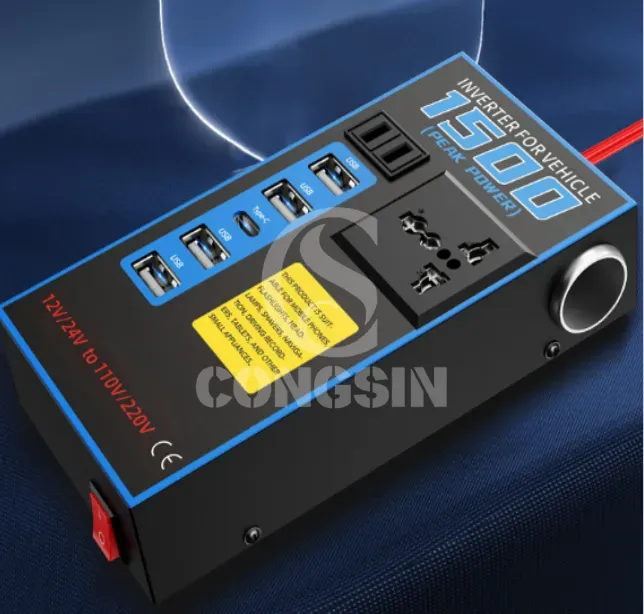
Congsin 1500W Inverter for Vehicle DC 12V/24V to AC 110V/220V with Universal socket Modified Sine Wave
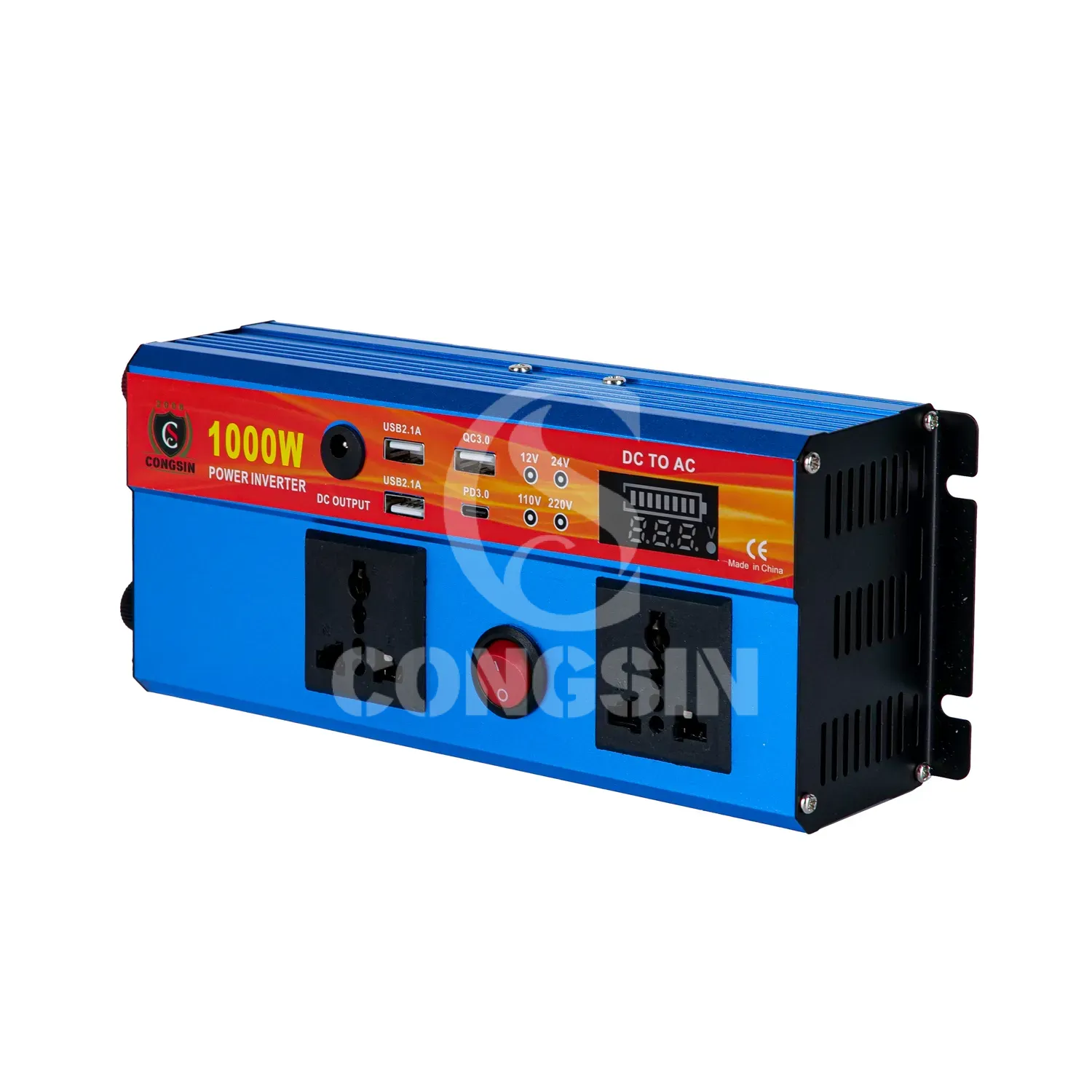
Congsin 1000W modified sine wave inverter with LED display and Type C port car RV power inverter
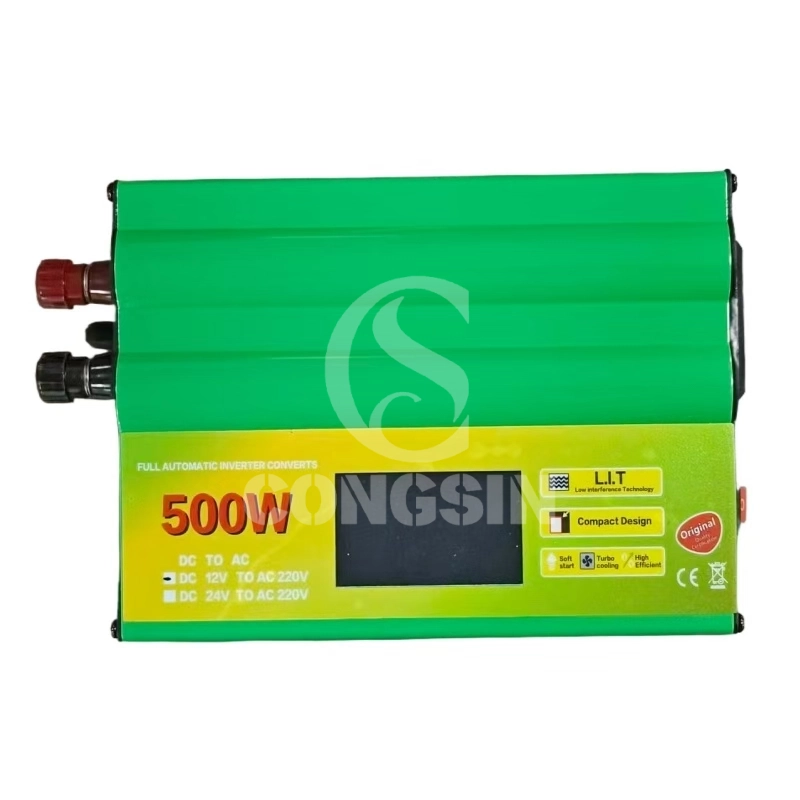
Congsin Modified Sine Wave Inverter 500W 1000W 1500W 12V LED Display Portable for RV Car Solar
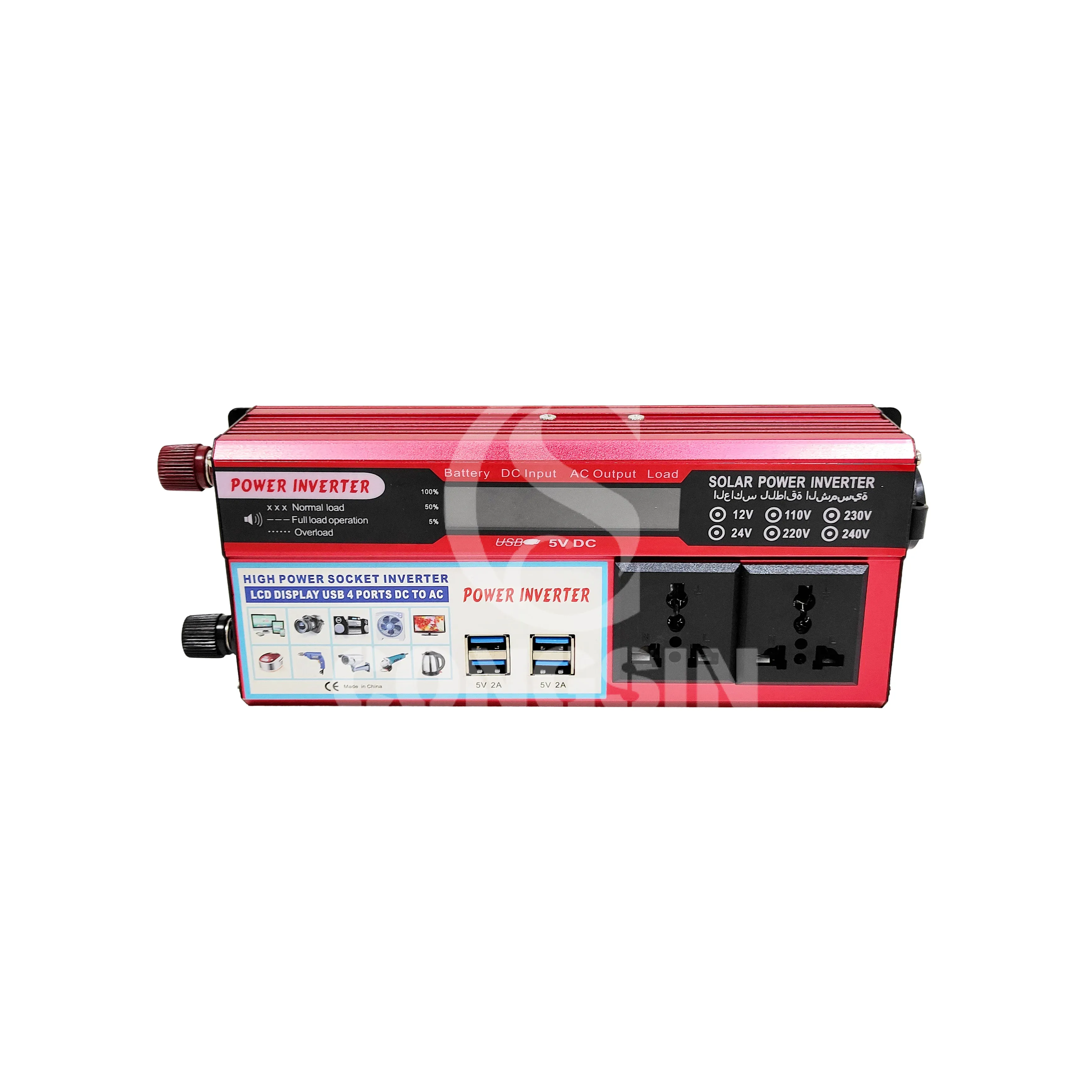
Congsin 1500W modified sine wave inverter with LCD display and USB ports for RV car boat home use

CONGSIN is a trusted OEM factory for power inverters, solar charge controllers, and DC converters. Reliable solutions for global B2B buyers.
 High Quality
 7/24 Service
 Guaranteed Warranty
© 2025 Congsin. All Rights Reserved.