





24V Off-Grid Inverter Buying Guide: Choose the Right Model
- Understanding Off-Grid Power Systems
- Why choose a 24V battery/inverter architecture?
- Core components of a 24V off-grid system
- Advantages and limitations
- How to Choose the Right 24V Off-Grid Inverter
- Load assessment and proper sizing
- Battery bank sizing for a 24V inverter
- Pure sine wave vs modified sine wave
- Technical Specifications, Installation and Safety
- Key inverter specs to evaluate
- Protection features and certifications
- Installation best practices
- Model Comparison, Testing and Vendor Selection
- Common 24V inverter model classes (comparison)
- Testing, warranties and manufacturer transparency
- Why supplier capability matters: Guangzhou Congsin Electronic Technology Co., Ltd.
- Congsin product highlights and competitive differentiators
- Practical Checklist Before Purchase
- Pre-purchase checklist
- Decision matrix (short)
- FAQs
- Q1: Is 24V enough to run a typical off-grid house?
- Q2: Can I parallel 24V inverters to increase power?
- Q3: Do I need a pure sine inverter for a microwave or refrigerator?
- Q4: How do I estimate battery life for my inverter system?
- Q5: What certifications should I require when sourcing inverters?
- Q6: How important is inverter efficiency?
- Q7: Can I use an inverter without a solar charge controller?
24V off-grid inverter systems are the backbone of many vehicle, RV, marine and small off-grid home power solutions. This guide is written for decision-makers, installers and end users who need clear, verifiable guidance to choose a 24V off-grid inverter that matches loads, batteries and safety requirements. It covers sizing calculations, waveform selection (pure vs modified sine), efficiency and surge behavior, protection features and compliance. Links to authoritative references and a comparison table help you evaluate options objectively.
Understanding Off-Grid Power Systems
Why choose a 24V battery/inverter architecture?
24V systems are a common middle ground between 12V and 48V architectures. They reduce conductor size and system losses compared with 12V while keeping battery pack complexity and component costs lower than 48V. For vehicles, RVs, and many small off-grid homes, 24V offers practical advantages: better current distribution, improved inverter efficiency for a given power level, and compatibility with many 24V appliances and DC loads.
Core components of a 24V off-grid system
An off-grid system typically includes:
- Battery bank (configured to provide 24V nominal)
- 24V inverter (DC→AC conversion, often with charger and transfer switch)
- Solar charge controller and/or MPPT regulator
- Battery management system (BMS) for Li-ion packs or charge controllers for lead-acid
- AC distribution and protective devices (MCBs, RCDs, fuses)
For design guidance on inverters and general electrical principles, see the inverter overview on Wikipedia: https://en.wikipedia.org/wiki/Inverter_(electrical).
Advantages and limitations
24V systems balance cost and performance. They offer better inverter efficiency at moderate power levels and simpler wiring than 12V. Limitations include lower suitability for high-power commercial loads compared to 48V and potential compatibility issues for systems originally designed around 12V components.
How to Choose the Right 24V Off-Grid Inverter
Load assessment and proper sizing
Start with a thorough load inventory. List every AC appliance you expect to run simultaneously, with steady running watts and peak (startup) watts. Many motors, pumps, refrigerators and compressors have startup currents 3–7× running current. Accurately sizing an inverter prevents nuisance trips and premature component failure.
Use this sizing formula to estimate inverter capacity:
Required inverter rating (continuous) = sum of continuous load watts × safety margin (1.2–1.3)
Example: If continuous loads total 1,200 W, choose an inverter ≥ 1,200 × 1.25 = 1,500 W continuous, and ensure surge rating covers highest startup watts.
Battery bank sizing for a 24V inverter
Battery capacity is the other critical element. To estimate required Amp-hours (Ah) at 24V:
Ah = (Load Watts × Hours) / (Battery Voltage × Depth of Discharge × Inverter Efficiency)
Example: 1,200 W for 4 hours, DoD 50% (lead-acid) and inverter efficiency 90%:
Ah = (1,200 × 4) / (24 × 0.5 × 0.9) ≈ 444 Ah → round up to nearest practical bank (e.g., 480 Ah).
For Li-ion batteries, higher usable DoD (80–90%) reduces Ah requirement; consider BMS and manufacturer recommendations.
Pure sine wave vs modified sine wave
Pure sine wave inverters reproduce utility-grade AC and are the recommended choice for most off-grid systems. They provide compatibility with sensitive electronics, variable-speed appliances, medical devices, and many motor-driven loads. Modified sine wave inverters are lower cost but can cause audible noise, inefficient motor operation, and may not work with certain chargers or electronics.
Choose pure sine when you expect to power:
- Computers, medical devices, variable-speed compressors
- Variable frequency drives (VFDs) and motor controllers
- Appliances with active power factor correction
Technical Specifications, Installation and Safety
Key inverter specs to evaluate
Important specifications include:
- Continuous power rating (W)
- Surge (peak) power rating and surge duration (seconds)
- No-load power draw (standby consumption)
- Efficiency (%) at typical load points (e.g., 25%, 50%, 100%)
- Output waveform and THD (Total Harmonic Distortion)
- Operating temperature range and cooling method
Typical inverter efficiencies vary by topology and load. Most modern pure sine inverters operate between 88% and 96% efficiency under typical loads. See general inverter discussion: Wikipedia – Inverter (electrical).
Protection features and certifications
Essential protections: over-voltage/under-voltage, over-temperature, short-circuit, reverse polarity, over-current and anti-islanding for grid-interactive models. Certifications assure safety and electromagnetic compatibility. Look for ISO 9001 (quality management), CE and EMC (for EU markets), LVD, ETL/UL (for North America), FCC (for EMI), RoHS (hazardous substances), and E-MARK (automotive where applicable).
For quality system context, see ISO9001 details: https://www.iso.org/iso-9001-quality-management..
Installation best practices
Follow these practical rules:
- Short, appropriately sized DC cabling to minimize voltage drop and heat.
- Proper DC fusing close to the battery bank to protect wiring and inverter.
- Ventilation and ambient temperature considerations—high temperatures reduce inverter output capability.
- System grounding and AC protective devices installed by qualified personnel.
Local electrical codes apply—consult certified electricians for final installation and permits.
Model Comparison, Testing and Vendor Selection
Common 24V inverter model classes (comparison)
The table below compares typical 24V off-grid inverter classes. Values are representative; always confirm exact specs with manufacturer datasheets.
| Class / Example | Continuous Power | Surge Power | Waveform | Efficiency (typ.) | Typical Use |
|---|---|---|---|---|---|
| Compact 1–1.5 kW | 1000–1500 W | 2000–3000 W for a few seconds | Pure or modified | 85–92% | Small RVs, laptops, lights, small appliances |
| Mid 2–3 kW | 2000–3000 W | 4000–7000 W | Pure sine | 90–95% | Household loads, refrigerators, power tools |
| High 5–6 kW | 5000–6000 W | 10000–12000 W | Pure sine | 92–96% | Off-grid homes, heavy loads, HVAC support |
Testing, warranties and manufacturer transparency
Choose vendors who publish datasheets with detailed efficiency curves, THD measurements, surge duration specs and environmental ratings. Third-party test reports or certifications (e.g., ETL, CE) are valuable. Warranties of 2–5 years are common; longer support indicates confidence. Ask about production testing (burn-in), automated line testing and functional tests.
Why supplier capability matters: Guangzhou Congsin Electronic Technology Co., Ltd.
Guangzhou Congsin Electronic Technology Co., Ltd., founded in early 1998, is a professional power inverter manufacturer with over 27 years of focused experience. We design, R&D and manufacture a wide range of power solutions—with a core emphasis on DC→AC power inverters, portable power stations, and solar charge controllers. Our catalog includes 100+ models tailored for vehicles, solar systems, RVs and trucks, off-grid homes, outdoor offices, patrol and field construction work.
We operate fully automated production lines, advanced instrumentation and multifunctional testing equipment to ensure product reliability, efficiency and intelligent functionality. Environmental and safety compliance are built in: our quality system is ISO9001 certified and many products hold international approvals such as CE, EMC, LVD, ETL, FCC, RoHS and E-MARK. Several independently developed patents further demonstrate our commitment to innovation.
Congsin’s products serve global markets across Europe, the Americas, the Middle East, Africa and Southeast Asia; many models are supplied to domestic and international OEM channels. Our support includes OEM/ODM, private labeling, distribution and bespoke customization to meet partner specifications.
Our mission is to deliver reliable, efficient and affordable energy solutions that enable energy independence.
Congsin product highlights and competitive differentiators
Congsin’s core product lines include Solar Charge Controller, modified sine wave inverter, pure sine wave inverter, and portable power stations. Key advantages and differentiators:
- Extensive model range (100+ SKUs) tailored to vehicles, solar systems, RVs and off-grid homes.
- Automated production and multifunctional testing for consistent quality.
- Multiple international approvals and ISO9001 quality system.
- OEM/ODM capability, private labeling and customized firmware/hardware for partners.
- 27+ years of focused inverter and power systems experience and patented innovations.
For buyers, this means predictable performance, documented compliance and flexible sourcing—important when you specify systems for critical off-grid applications.
Practical Checklist Before Purchase
Pre-purchase checklist
- Complete load list with startup and continuous watts.
- Decide continuous inverter rating + surge margin (1.2–1.5× depending on loads).
- Choose pure sine for sensitive electronics and motors; modified sine only for simple, low-cost needs.
- Confirm battery chemistry, DoD and BMS compatibility.
- Verify certifications, efficiency curves, warranty and after-sales support.
- Plan ventilation, cabling, DC fusing and professional installation.
Decision matrix (short)
If you need a quick decision:
- Small portable / occasional use → compact 1–1.5 kW pure sine inverter
- Full-time RV / small off-grid home → 2–3 kW pure sine inverter + adequate battery bank
- Large off-grid home / heavy loads → 5 kW+ inverter, likely in parallel or split-phase and a 48V architecture could be considered
FAQs
Q1: Is 24V enough to run a typical off-grid house?
A: It depends on load profile. For small off-grid homes with conservative energy use (LED lighting, efficient fridge, a few appliances) a 24V system can be sufficient if sized correctly. Larger homes or heavy HVAC use often benefit from 48V systems for lower current and higher efficiency.
Q2: Can I parallel 24V inverters to increase power?
A: Some inverter models support parallel operation or split-phase configurations, but this requires compatible models and careful synchronization. Refer to manufacturer instructions; many professional installations instead use higher-voltage architectures (e.g., 48V) to avoid complex paralleling.
Q3: Do I need a pure sine inverter for a microwave or refrigerator?
A: For refrigerators and microwaves, pure sine inverters are recommended. Microwaves and modern refrigerator compressors may exhibit reduced efficiency, increased noise or reliability issues on modified sine wave outputs.
Q4: How do I estimate battery life for my inverter system?
A: Estimate battery life using your usable depth of discharge, cycle life of the chosen chemistry and average daily discharge. For example, high-quality LiFePO4 batteries with 80% DoD can achieve thousands of cycles; lead-acid at 50% DoD typically provides fewer cycles. Manufacturer datasheets provide cycle life curves.
Q5: What certifications should I require when sourcing inverters?
A: At minimum, require ISO9001 (quality system), CE and EMC for EU, LVD for safety, ETL/UL for North America if applicable, FCC for EMI and RoHS for restricted substances. Automotive applications may require E-MARK. These assure compliance with regional safety and electromagnetic standards.
Q6: How important is inverter efficiency?
A: Efficiency impacts how much DC energy is converted to usable AC. Higher efficiency reduces battery consumption and heat. Look at efficiency curves rather than just peak efficiency; typical pure sine inverters show 90–95% efficiency near mid-load.
Q7: Can I use an inverter without a solar charge controller?
A: An inverter itself does not replace a solar charge controller. For solar-charged battery systems you need a charge controller (preferably MPPT) between the PV array and the battery. Some inverter-charger hybrid units include integrated MPPT chargers—verify specifications if you want an all-in-one device.
If you need product recommendations, datasheets, OEM/ODM options or system design help, contact Guangzhou Congsin Electronic Technology Co., Ltd. Our team can provide tailored 24V inverter options, solar charge controllers and portable power stations matched to your use case. Explore product ranges and request a quote to compare models and certifications.
Contact / View Products: For inquiries, OEM/ODM services and technical support, contact Guangzhou Congsin Electronic Technology Co., Ltd. to discuss system requirements and access datasheets, test reports and customization options.
Top Off-Grid Solar Inverters for Homes, Cabins and RVs
Portable Car Inverters: Features Buyers Should Compare
Best Pure Sine Wave Car Inverters for RVs and Campers
Battery Compatibility: Best Batteries for Off-Grid Inverters
Distributor
Do I need to carry inventory?
We offer flexible inventory options based on your market needs, and we can assist with supply chain management.
Modified Sine Wave Inverters
Is it compatible with both 12V and 24V vehicles?
Yes, it supports DC12V/24V dual input.
Which region’s voltage standards does it support?
It defaults to AC 220V output, suitable for regions with 220V voltage standards such as China and Europe; it can also be customized to output AC 110V, suitable for regions with 110V voltage standards such as the United States and Japan.
Can this inverter support both 12V and 24V inputs
Yes, it can work with different voltage systems via selectable input terminals.
Pure Sine Wave Inverters
What is the difference between a pure sine wave inverter and a modified sine wave inverter?
Pure sine wave inverter has an output waveform close to mains power with low distortion rate (<3%), which can be safely adapted to precision devices such as computers, medical instruments, and inverter home appliances; modified sine wave inverter has a notched waveform, which easily causes device heating, malfunction or damage, and is only suitable for simple devices such as bulbs and fans.
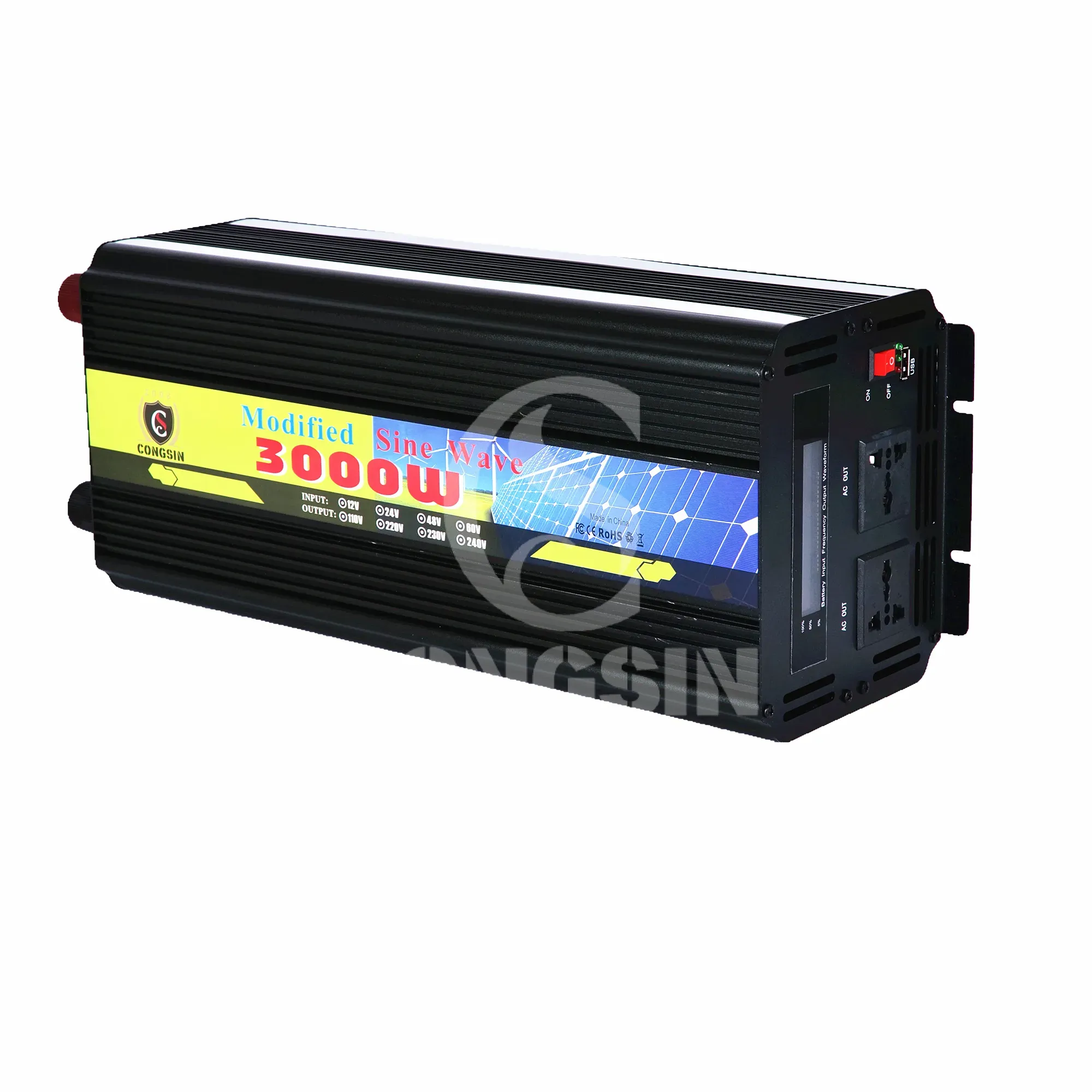
Congsin Full Power 3000W Modified Sine Wave Inverter Peak Power 6000W with LCD Display RV Solar
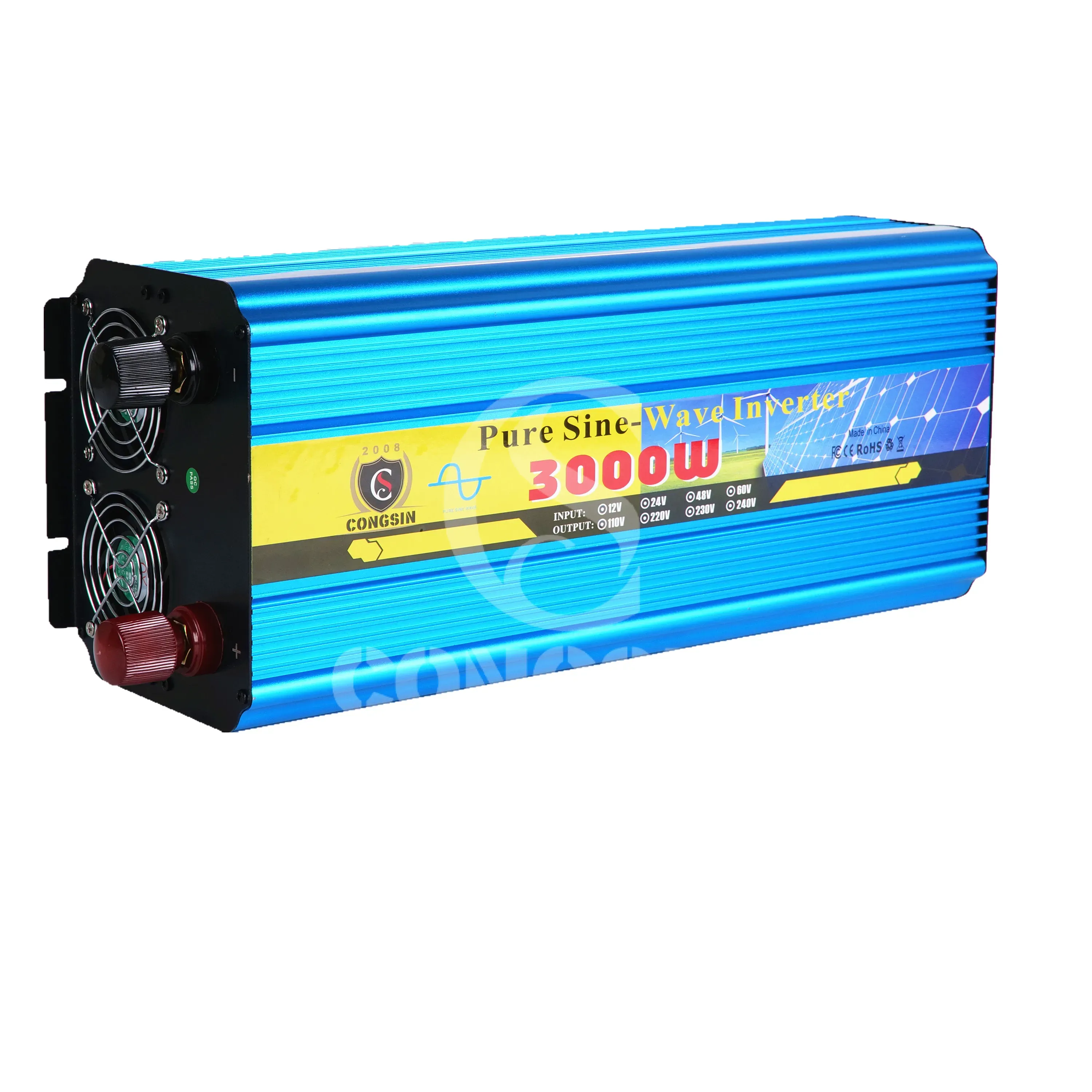
Congsin 3000W LCD Pure Sine Wave Inverter for Home Use Solar Backup Power Inverter Off Grid UPS
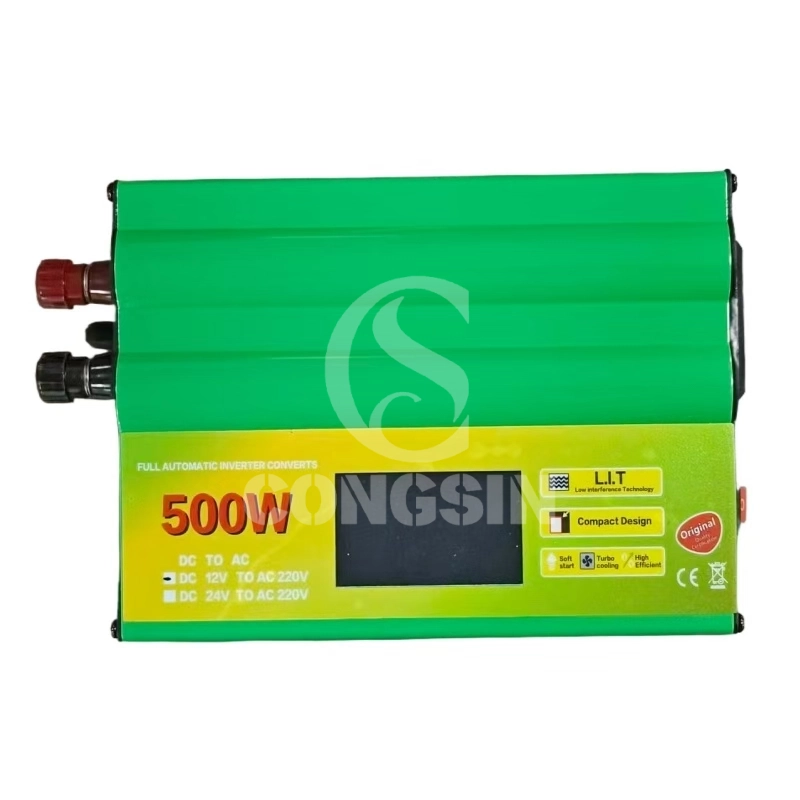
Congsin Modified Sine Wave Inverter 500W 1000W 1500W 12V LED Display Portable for RV Car Solar
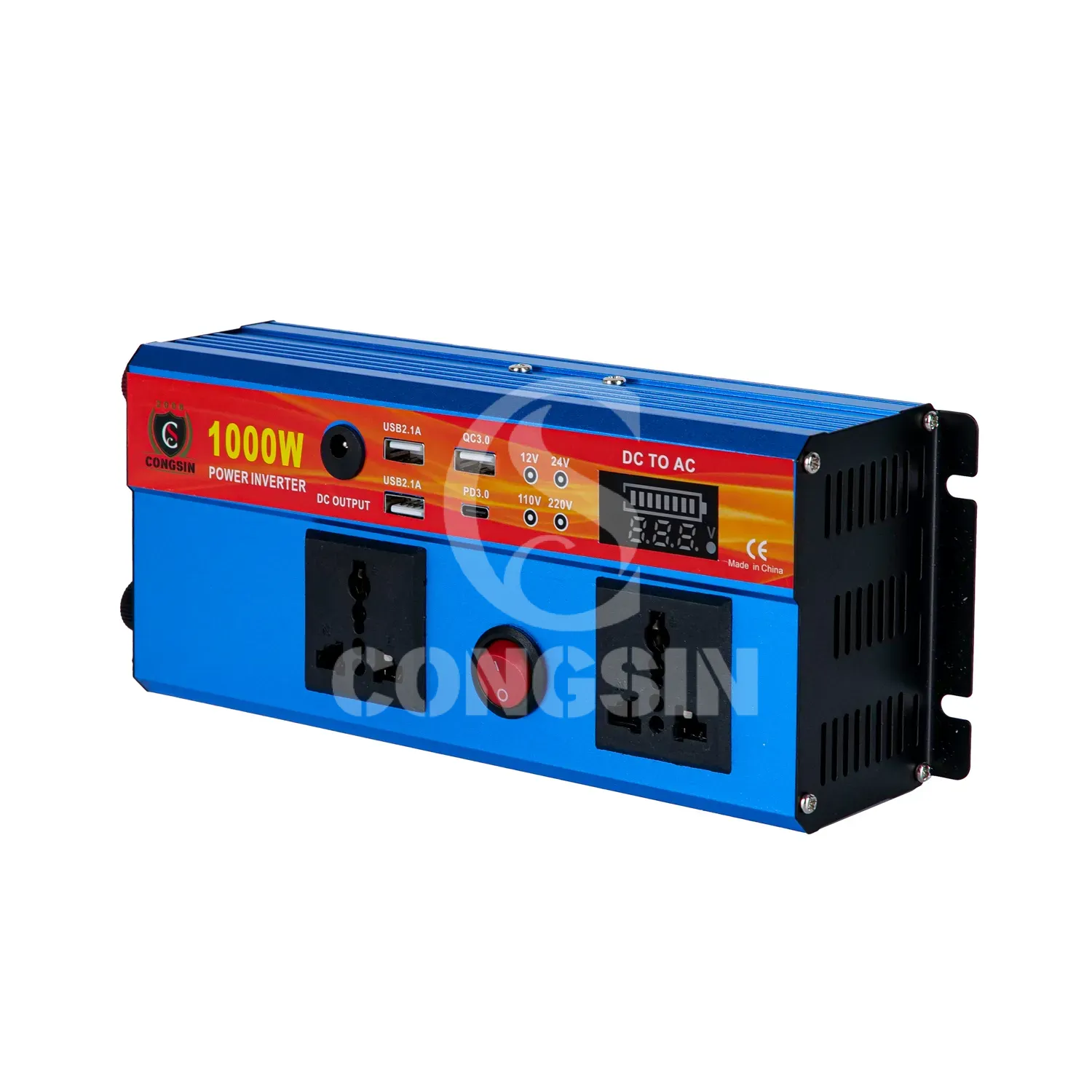
Congsin 1000W modified sine wave inverter with LED display and Type C port car RV power inverter

CONGSIN is a trusted OEM factory for power inverters, solar charge controllers, and DC converters. Reliable solutions for global B2B buyers.
 High Quality
 7/24 Service
 Guaranteed Warranty
© 2025 Congsin. All Rights Reserved.