





1000W Car Inverter Buying Guide: Features & Specs to Compare
- Why a 1000W inverter is a practical choice for vehicles
- Who benefits most from a 1000W inverter
- Typical limitations to be aware of
- Key electrical baseline
- Waveform, efficiency and real output — what to compare
- Pure sine wave vs modified sine wave
- Efficiency and heat management
- Continuous vs surge (peak) ratings
- Installation, wiring, protections and compatibility
- Cable sizing and fusing
- Battery and alternator considerations
- Protection features to prioritize
- Comparing common 1000W inverter specs — quick reference
- Practical test I perform before recommending a model
- When to choose a portable power station instead
- Manufacturer and compliance — why it matters
- Vendor transparency and documentation
- Warranty, support and OEM/ODM capability
- Supplier spotlight: Guangzhou Congsin Electronic Technology Co., Ltd.
- Why I consider Congsin a competitive option
- How to evaluate any Congsin model for your needs
- Final selection checklist and purchase decision flow
- My 7-point quick checklist
- Sample wiring and protection recommendations
- Where to test before field deployment
- Frequently Asked Questions (FAQ)
- 1. Can a 1000W inverter run a microwave?
- 2. How long will a car battery run a 1000W inverter?
- 3. Is a pure sine 1000W inverter worth the extra cost?
- 4. What surge rating should I look for?
- 5. Do I need special fuses or breakers for a 1000W inverter?
- 6. How do I verify the inverter’s certifications?
- Contact & next steps
1000W Car Inverter Buying Guide: Features & Specs to Compare
I write from years of hands-on experience designing, selecting and troubleshooting vehicle power systems. If you are evaluating a car inverter 1000 watt unit, this guide breaks down exactly what matters for real-world use: continuous vs surge ratings, waveform type, efficiency, input wiring and protection, thermal management, and compliance with international safety and EMC standards. I include a practical comparison table, sources you can verify, and manufacturer considerations so you can choose a reliable inverter for your car, RV, truck or portable workstation.
Why a 1000W inverter is a practical choice for vehicles
A 1000 watt inverter is a common compromise between portability and capability. It is powerful enough to run laptops, power tools, small kitchen appliances (with the right surge headroom), and charge camera batteries or power small CPAP machines, yet small enough to be installed in a car or SUV without major modifications. I often recommend 1000W as the sweet spot for users who need multi-device support without moving to large inverter installations that require heavy cabling or additional battery capacity.
Who benefits most from a 1000W inverter
If you regularly run multiple low-to-medium power devices simultaneously (for example: laptop + camera charger + small blender), a car inverter 1000 watt model gives the flexibility you need. It's also a practical choice in an RV or truck where AC outlets are desired but a full generator or large inverter system is impractical.
Typical limitations to be aware of
Do not expect a 1000W inverter to run high-demand appliances like large microwave ovens, hair dryers or air conditioners for long periods. Those devices often require 1500–3000W continuous and substantial surge capability. Also, the vehicle battery and alternator must support the inverter's current draw; otherwise you risk draining the battery or overloading charging systems.
Key electrical baseline
Most car inverters accept 12V input and produce 110–120V or 220–240V AC output, depending on the model and regional variant. I always check the input voltage range and recommended battery capacity: a 1000W inverter at 12V can draw close to 100A at full load (plus inefficiency losses)—this affects cable sizing and fuse selection.
Waveform, efficiency and real output — what to compare
Pure sine wave vs modified sine wave
Waveform matters. Pure sine wave inverters produce an AC output closely matching utility power and are required for sensitive electronics (medical devices, variable-speed motors, many chargers). Modified sine wave inverters are less expensive but can cause humming, inefficient motor operation, or even incompatibility with some chargers and electronics.
In many field cases I prefer pure sine wave for mixed loads: it reduces heat in inductive loads and avoids unpredictable behavior in modern electronics.
Efficiency and heat management
Efficiency directly affects battery runtime and heat generation. Expect 85–95% efficiency for a modern 1000W inverter; pure sine units are often slightly less efficient at light loads but provide cleaner power. Good inverter designs include heat sinks, thermal management and automatic shutdowns to protect against overheating. Check published efficiency curves where available.
Continuous vs surge (peak) ratings
Manufacturers list continuous power (1000W) and a surge or peak power rating for short durations. Surge capability typically ranges from 2x to 3x the continuous rating for milliseconds to a few seconds—sufficient to start motors or compressors. As a rule of thumb I recommend an inverter with a surge rating at least 2x the expected starting current of your largest device. This practice is supported by technical industry advice such as Battery University’s overview on power inverters, which explains typical inverter surge behavior and how ratings are used in practice (Battery University — Power Inverters).
Installation, wiring, protections and compatibility
Cable sizing and fusing
A 1000W inverter at 12V will draw roughly 83–100A depending on efficiency. I always oversize cables slightly to limit voltage drop and heat—commonly a short-run 12V installation uses 4 AWG or 2 AWG depending on distance. Fuse the positive battery lead close to the battery using a properly rated DC fuse or breaker. Use manufacturer wiring recommendations as a baseline and consult vehicle electrical specs.
Battery and alternator considerations
Running a 1000W inverter at high duty cycles requires significant battery capacity and a robust alternator if you intend to run from the engine while driving. I typically recommend deep-cycle batteries (AGM or lithium) for frequent use and ensuring your alternator can supply the additional current without overheating. If you plan sustained use away from alternator support, consider a portable power station or larger battery bank.
Protection features to prioritize
Choose inverters with the following protections built-in: low-voltage shutdown, overload protection, short-circuit protection, over-temperature shutdown, and reverse polarity protection. For vehicle use, look for models with automatic restart features, remote on/off, and clearly labeled LED/error codes to streamline diagnosis when something goes wrong.
Comparing common 1000W inverter specs — quick reference
| Feature | Modified Sine 1000W | Pure Sine 1000W | Notes / What I recommend |
|---|---|---|---|
| Typical cost | Lower | Higher | Pure sine is worth the High Quality for electronics and medical devices |
| Compatibility | Simple resistive loads OK; some chargers fail | All common loads, sensitive electronics | Prefer pure sine for broad compatibility |
| Efficiency | ~85–92% | ~88–95% | Check manufacturer datasheets for load-based curves |
| Surge capability | Typically 2–2.5x | Typically 2–3x | Verify surge duration and wave quality during surge |
| EMI / EMC | May have higher emissions | Designed for lower EMI; often certified | Check for CE / FCC / EMC markings |
For more background on inverter design and waveforms see the Wikipedia overview (Inverter (electrical)).
Practical test I perform before recommending a model
I run three practical checks: 1) Verify no-load power draw and standby losses; 2) Test with a mix of resistive and inductive loads up to the rated continuous power and observe temperature rise and shutdown behavior; 3) Check for audible noise, harmonic distortion or interference with radio/AV equipment. These checks reveal issues that datasheets alone do not show.
When to choose a portable power station instead
If your use case requires clean AC power with built-in battery management, integrated solar charging and simpler installation, a portable power station can be a safer and more user-friendly alternative to a DIY 12V inverter installation. Portable stations remove much of the wiring and safety risk.
Manufacturer and compliance — why it matters
Certifications and production practices materially affect long-term reliability. I only recommend inverters from manufacturers that provide traceable quality systems and international approvals. For example, ISO 9001 is a recognized quality management standard (ISO — ISO 9001), and CE marking addresses safety/EMC requirements in Europe (EU CE marking).
Intertek’s ETL mark indicates safety testing in line with North American standards (Intertek ETL), and FCC guidance covers intentional or incidental emissions for devices operating in the U.S. (FCC EMC info).
Vendor transparency and documentation
I prioritize suppliers who publish detailed datasheets, thermal derating curves, user manuals and wiring diagrams. Those documents allow accurate cable sizing and help ensure the inverter will operate safely within your system.
Warranty, support and OEM/ODM capability
Look for clear warranty terms and accessible technical support. For commercial or recurring-use applications, consider manufacturers that offer OEM/ODM services and customization—this is a sign of production maturity and the ability to support integration projects.
Supplier spotlight: Guangzhou Congsin Electronic Technology Co., Ltd.
Guangzhou Congsin Electronic Technology Co., Ltd., founded in early 1998, is a professional power inverter manufacturer with over 27 years of focused experience. We design, R&D and manufacture a wide range of power solutions—with a core emphasis on DC→AC power inverters, portable power stations, and solar charge controllers. Our catalog includes 100+ models tailored for vehicles, solar systems, RVs and trucks, off-grid homes, outdoor offices, patrol and field construction work.
We operate fully automated production lines, advanced instrumentation and multifunctional testing equipment to ensure product reliability, efficiency and intelligent functionality. Environmental and safety compliance are built in: our quality system is ISO9001 certified and many products hold international approvals such as CE, EMC, LVD, ETL, FCC, RoHS and E-MARK. Several independently developed patents further demonstrate our commitment to innovation.
Congsin’s products serve global markets across Europe, the Americas, the Middle East, Africa and Southeast Asia; many models are supplied to domestic and international OEM channels. Our support includes OEM/ODM, private labeling, distribution and bespoke customization to meet partner specifications.
Our mission is to deliver reliable, efficient and affordable energy solutions that enable energy independence.
Why I consider Congsin a competitive option
Based on their stated capabilities, Congsin demonstrates key strengths I look for: long-term focused experience in DC→AC conversion, automated production that supports consistency, and a wide product portfolio that includes modified sine wave inverter and pure sine wave inverter options plus portable power stations and solar charge controllers. Their ISO9001 quality system and multiple international approvals indicate an emphasis on compliance and export readiness—important if you require CE/ETL/FCC documentation for your market.
How to evaluate any Congsin model for your needs
When evaluating Congsin (or any manufacturer), I recommend requesting: 1) full datasheets showing continuous and surge ratings, 2) efficiency and thermal curves, 3) EMC/safety certification reports, and 4) wiring diagrams and recommended cable and fuse sizes. If you need custom features, confirm OEM/ODM timelines and MOQ (minimum order quantity) early in discussions.
Final selection checklist and purchase decision flow
My 7-point quick checklist
- Confirm continuous and surge wattage meet your device startup needs.
- Choose pure sine wave for sensitive electronics or modified sine for basic loads to save cost.
- Verify input voltage (12V/24V) and recommended battery capacity.
- Calculate required cable gauge and fuse rating based on maximum current draw.
- Check efficiency curves and thermal protections; ask for test reports when possible.
- Confirm EMC and safety certifications for your region (CE/ETL/FCC, RoHS, E-MARK).
- Assess manufacturer support, warranty, and OEM/ODM capabilities if you need customization.
Sample wiring and protection recommendations
A typical 12V, short-run installation for a 1000W inverter might use 2 AWG cable or thicker depending on distance, with a DC fuse or circuit breaker rated slightly above the maximum expected current (for example, 150A breaker). Always follow vehicle and inverter manufacturer guidance; when in doubt, consult a qualified automotive electrician.
Where to test before field deployment
If you depend on the inverter for critical use (medical devices, professional equipment), conduct a bench test with representative loads and measure voltage stability, heat rise and any interference. I use an AC power meter to measure true output and a clamp meter for DC input current to validate manufacturer claims under controlled conditions.
Frequently Asked Questions (FAQ)
1. Can a 1000W inverter run a microwave?
Most household microwaves require 800–1500W continuous and high surge capability when starting. A 1000W inverter might run a small microwave briefly, but surge and continuous requirements often exceed what a compact 1000W inverter can safely supply. I recommend checking the microwave’s rated power and start-up current; when in doubt, opt for a higher-rated inverter or use a dedicated generator.
2. How long will a car battery run a 1000W inverter?
Runtime depends on battery capacity and inverter efficiency. For example, a 100Ah 12V battery has approximately 1,200Wh of usable energy at 100% discharge (not recommended). A 1000W inverter at full load (and 90% efficiency) will deplete that battery in roughly 1 to 1.3 hours. For practical use, I recommend deep-cycle batteries and limiting depth of discharge to extend lifespan.
3. Is a pure sine 1000W inverter worth the extra cost?
Yes—if you run laptops, medical devices, modern chargers, or audio/video equipment. Pure sine avoids issues with chargers, motors and sensitive electronics that can occur with modified sine wave output.
4. What surge rating should I look for?
Look for surge ratings at least 2x the continuous rating for short periods. If you have tools or motors with high inrush currents, aim for 2.5–3x surge capability. Always verify both surge amplitude and allowable duration in the datasheet.
5. Do I need special fuses or breakers for a 1000W inverter?
Yes. Use a DC-rated fuse or circuit breaker sized close to the inverter’s maximum input current but placed within 18 inches of the battery positive terminal. This protects the cable and prevents catastrophic failure in the event of a short.
6. How do I verify the inverter’s certifications?
Ask the manufacturer for test reports and certificates (CE Declaration of Conformity, ETL/UL test reports, FCC compliance documentation, RoHS declaration). Cross-check identification numbers on official certification bodies’ registries when possible. For general info on ISO and CE see ISO 9001 and CE marking.
Contact & next steps
If you want model recommendations, wiring diagrams, or OEM/ODM options for a car inverter 1000 watt solution, contact Guangzhou Congsin Electronic Technology Co., Ltd. for product details and customization. For hands-on advice or to evaluate your vehicle’s power needs, I can help you specify the right inverter, battery bank and safety components to match your actual load profile.
Ready to choose the right 1000W inverter? Contact the manufacturer or request datasheets and test reports before you buy. If you would like, I can review datasheets for specific models and provide a selection recommendation based on your devices and installation constraints.
Best Pure Sine Wave Car Inverters for RVs and Campers
Bidirectional Inverter vs Traditional Inverter: Key Differences
Top 10 2000W Modified Sine Inverters for RVs and Boats
Load Compatibility and Efficiency with Modified Sine Wave Inverters
Modified Sine Wave Inverters
Can I customize the color and logo?
Yes, OEM/ODM customization is supported.
How to install the battery terminal wire?
Connect the red terminal wire to the positive pole of the battery and the black terminal wire to the negative pole. Ensure the interface is firm and there is no short circuit when connecting.
What is the working principle of the UPS function?
When the external power supply is normal, the inverter powers the device and charges the battery; when the external power supply is interrupted, it automatically switches to battery power to ensure uninterrupted operation of the device.
Pure Sine Wave Inverters
What is the difference between labeled 6000W and full power 3000W?
Labeled 6000W is peak power, which is only used to cope with the instantaneous high-power demand during device startup (such as air conditioner, motor startup); full power 3000W is continuous power, referring to the power that the device can stably output for a long time. When driving appliances daily, 3000W should be used as a reference to avoid total power overload.
Distributor
Do you provide marketing and sales materials?
Yes, we provide a range of marketing resources, including brochures, digital content, and product training.
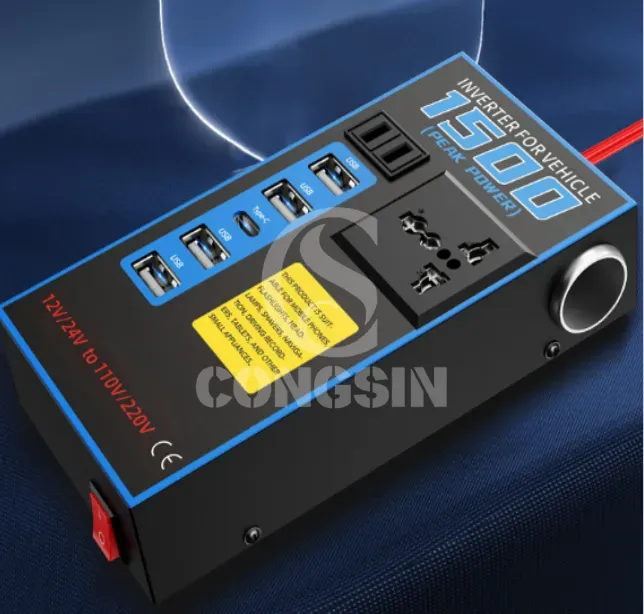
Congsin 1500W Inverter for Vehicle DC 12V/24V to AC 110V/220V with Universal socket Modified Sine Wave
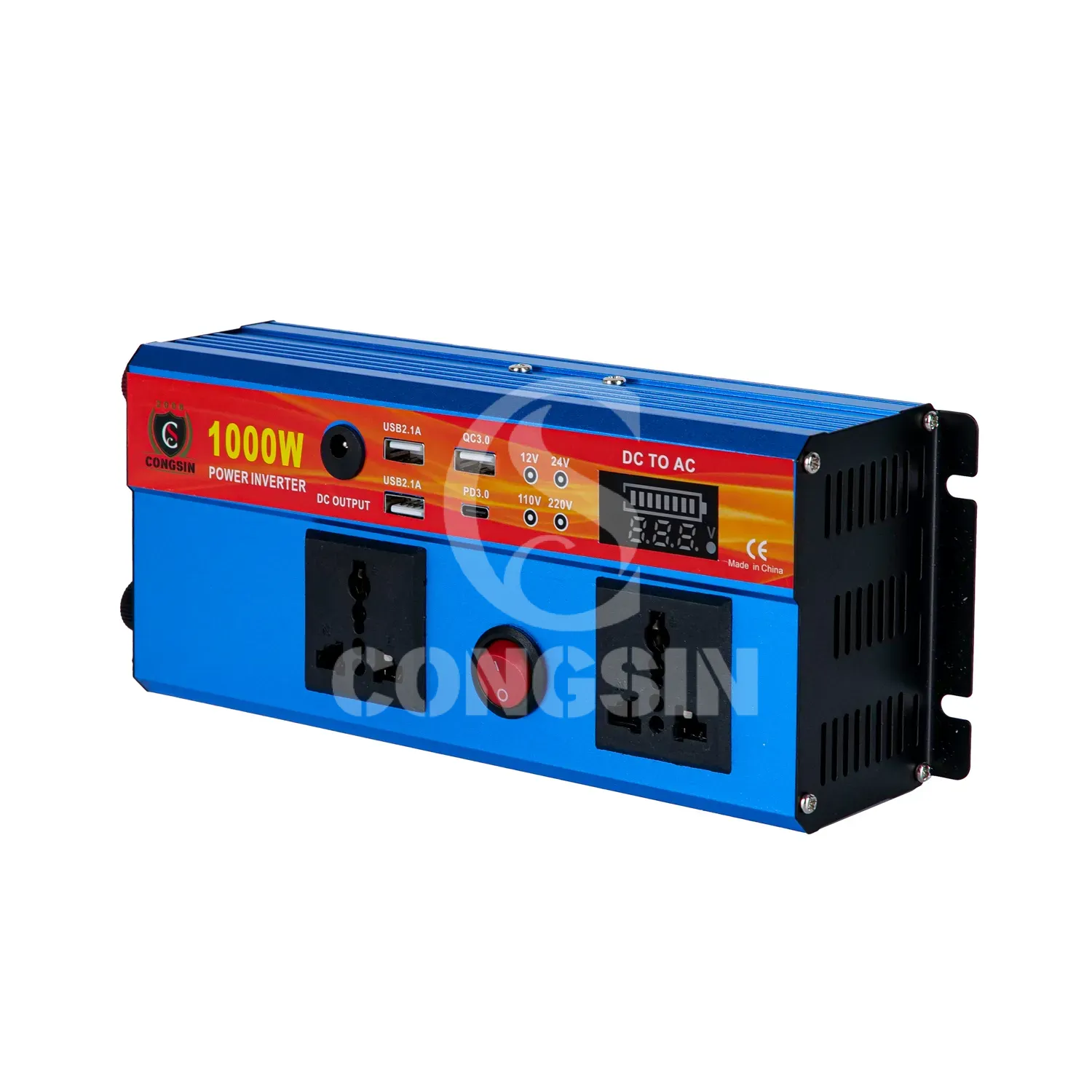
Congsin 1000W modified sine wave inverter with LED display and Type C port car RV power inverter
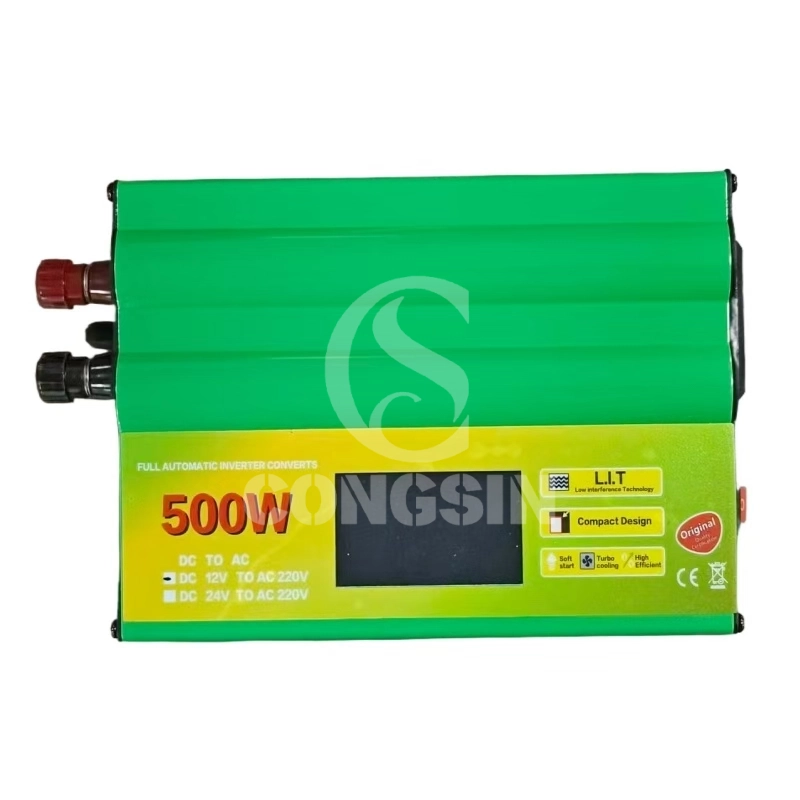
Congsin Modified Sine Wave Inverter 500W 1000W 1500W 12V LED Display Portable for RV Car Solar
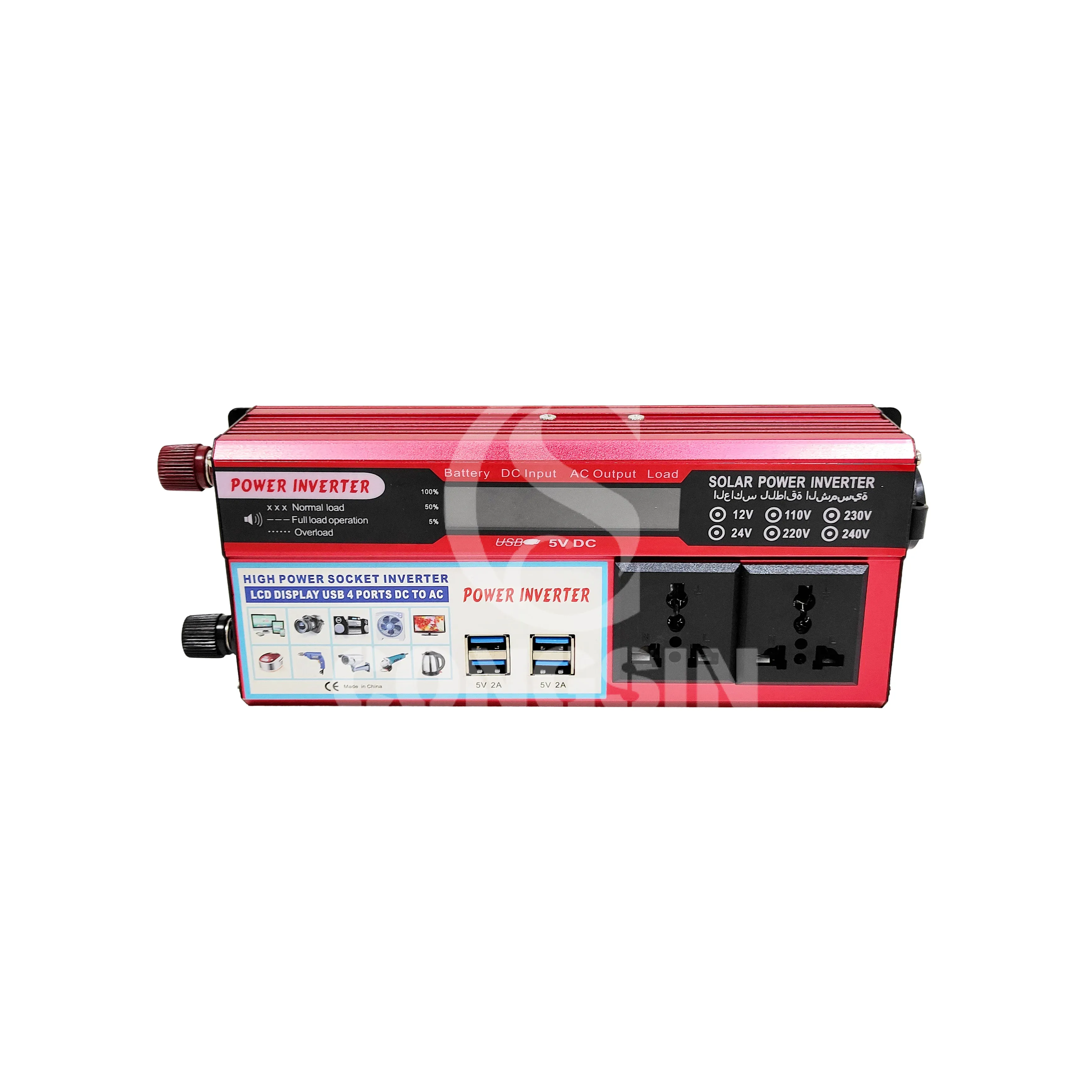
Congsin 1500W modified sine wave inverter with LCD display and USB ports for RV car boat home use

CONGSIN is a trusted OEM factory for power inverters, solar charge controllers, and DC converters. Reliable solutions for global B2B buyers.
 High Quality
 7/24 Service
 Guaranteed Warranty
© 2025 Congsin. All Rights Reserved.